
Frequently asked questions: Master of Applied Data Science program
Program questions
Yes, the MADS program is a 100% online master’s degree designed to provide global access to a data science education from one of the top public universities in the United States. Courses are hosted on Canvas, a widely used learning platform, and all course content is accessible through a web browser. You will collaborate with fellow students via Slack and receive direct access to faculty through live office hours, Slack and email. Faculty will know who you are, respond to your questions and care about your goals.
The MADS program attracts driven students from diverse academic and professional backgrounds. Many are working professionals looking to upskill or pivot into data-focused roles at their current organizations. Others are career changers who land their first jobs in the data science field after graduating. Because MADS courses are asynchronous, students are able to join us from Michigan and across the globe, including caregivers, active-duty service members, veterans and professionals at all career stages, from recent graduates to senior leaders and CEOs.
We welcome applicants from all academic and professional backgrounds, including non-technical backgrounds. You do not need to have an undergraduate degree in computer science. As long as you can demonstrate basic Python proficiency through your placement test, we encourage you to apply. U-M offers low-cost online programming courses, taught by UMSI faculty, that are a good fit for applicants who need to develop these foundational skills. The popular Python 3 Programming Specialization teaches the skills needed for the program — and applicants who successfully complete the five-course series will qualify for a standard placement waiver.
Full-time students with advanced placement may complete the program in as little as 12 months, while those with standard placement can complete the program in 16 months. The majority of MADS students enroll part time, typically completing the program in 2-3 years.
Each course requires approximately 9-12 hours per week. Time commitments vary depending on course type, your background knowledge and how many credits you take at once. Assignments for courses are always due on Tuesdays, allowing you to build a predictable routine that carries throughout your time in the program.
The MADS program is designed to fit into your life. All of the coursework is asynchronous, so you can complete it on your own schedule. This is especially helpful for students balancing a full-time job, active-duty service members, and those with caregiving responsibilities. Instructors show flexibility and understanding when things come up — whether that’s a family vacation, a busy sprint at work or a medical procedure.
If you ever need to take time off, that's an option too. While most students complete the program without extended breaks, you're welcome to pause your studies for personal or professional reasons. You can take up to a year away without needing to reapply.
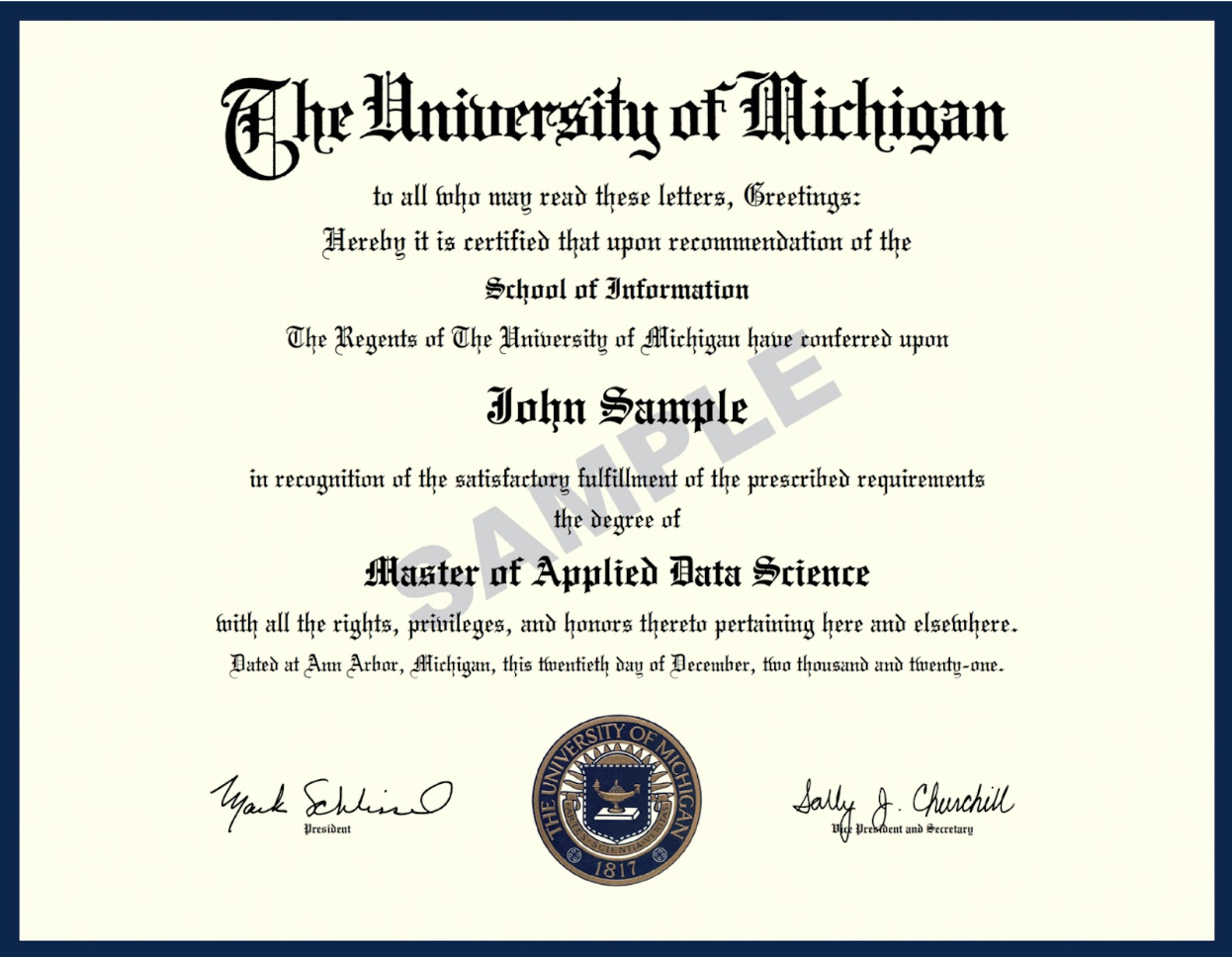
The MADS diploma and transcript are identical to those earned by graduates of other programs at the fully-accredited University of Michigan School of Information. These documents do not differentiate between residential and online degree programs.
MADS operates on a three-term academic year: Fall, Winter, and Spring/Summer. Most courses are one month long and worth one credit. The exceptions include:
- Data-Oriented Python Programming and Debugging (4 credits, 16 weeks)
- Milestone I and Milestone II (2 credits each, 8 weeks)
- Capstone (3 credits, 12 weeks)
MADS is a fully online degree offered by the School of Information. The MS DS is an on-campus degree offered by LSA. While the MS DS has one annual admissions cycle with limited spots in each class, the MADS program admits students three times per year, with the flexibility to admit all qualified applicants. When deciding between programs, we encourage you to think about your learning style and lifestyle. For a more in-depth comparison, it may be useful to explore each program’s curriculum.
Demand for data scientists is high across industries, because they help organizations make better decisions, improve business processes, and develop new products and services. The United States Bureau of Labor Statistics predicts that employment of data scientists will grow 36 percent between 2023 and 2033 – much faster than the average of all occupations.
MADS graduates go on to work in technology, financial services, manufacturing, consulting, health care and more, with graduates who accept their first job in the data science field earning an average salary of $107K. View recent career outcomes here.
The MADS program prepares data scientists who can lead in an AI-driven world. You will graduate fluent in the tools and techniques reshaping every industry.
The most exciting era for data science may very well still be ahead. While AI can automate parts of the workflow, it’s not as reliable or effective as data scientists at making decisions about how data is acquired, framing problems or interpreting results in context.
Demand will continue to grow for professionals who understand how AI models work, can exercise technical and ethical judgment, and have the expertise to catch errors and manage risk. Most important of all is the ability to translate outputs into insights for non-technical stakeholders, driving decisions. By leveraging agentic AI, data scientists can spend less time on rote work and more time on strategic thinking, improving the quality and speed of their decision making.
The MADS program builds these skills throughout the curriculum, with a deep focus on machine learning, natural language processing, and generative AI, including courses in Applications of Generative AI and Generative AI in Business and Society. To develop advanced expertise in AI and machine learning, including generative AI, reinforcement learning and advanced deep learning, you can pursue an optional concentration in Artificial Intelligence.
Yes! As a MADS student, you will have the opportunity to be online with classmates during weekly synchronous office hours, which are held at different times to suit a range of schedules and time zones. You will also interact, almost daily, with your peers on the program’s Slack workspace. Strong bonds often form during classes, with students arranging informal study groups. During milestone and capstone courses, these bonds will deepen as you work on projects with classmates from around the world. The student-led MADS Association hosts virtual town halls each month on relevant topics, which are attended by the program director. You will also be invited to attend commencement in person and to join an optional MADS On-Campus Experience on the University of Michigan campus, held annually during Homecoming Weekend.
Your instructors in the MADS program are the same faculty who teach our residential programs in Ann Arbor, Michigan, plus industry experts who understand employers’ current needs and are actively involved in solving real-world data challenges.
Yes. MADS students receive U-M email accounts, access to campus facilities including libraries, gyms and academic buildings, and wraparound support including academic advising and career coaching.
You can explore the MADS curriculum here. The rigorous curriculum prepares you to be a leader in data science by combining core data science technical courses with courses on persuasive communication, qualitative inquiry and data ethics. You will work with real-world data sets.
MADS students are not required to pursue a concentration, but choosing a concentration can help you tailor your learning to specific career goals and gain a competitive edge in the job market. We offer two concentrations in high-demand areas — Artificial Intelligence and Data Analytics — which you can declare at any point before you graduate. Each concentration consists of four electives chosen from an approved list of courses. Learn more about concentrations.
Internships are not required, but many students pursue them. MADS students have access to UMSI’s Career Development Office for support in the internship search.
As a MADS student, you’ll have access to a team of career coaches in UMSI’s Career Development Office who provide personalized guidance on navigating your job search or pursuing career advancement. You will also receive access to UMSI CareerLink, a database of job postings and employer contacts only available to students and alumni of the School of Information. Graduates also benefit from becoming part of the University of Michigan’s network of more than 668,000 alumni worldwide.
Admissions questions
Visit the online application to get started!
No, there is no fee to apply to the Master of Applied Data Science program.
The MADS application process is straightforward and designed for busy professionals. There is no application fee. Applicants from all academic and professional backgrounds are welcome, as long as you have basic Python skills — we do not consider your undergraduate GPA or prior work experience, and we do not require essays or the GRE.
After submitting your application, qualified applicants will be admitted. You will then complete a placement test so we can find the right starting point for you in the program. You can choose between the standard or advanced placement test, or see if you qualify for a waiver.
You can reach out to talk to us in more depth about your qualifications, and receive individualized guidance on fulfilling requirements, by emailing [email protected].
Because MADS is a graduate-level program taught in English, non-native English speakers must submit TOEFL or IELTS scores. The recommended TOEFL score is 5+ overall and in each section on the new TOEFL scale (100+ overall with 25+ in each section on the previous TOEFL scale). The recommended IELTS score is 7+ overall and in each section. This requirement may be waived if you completed a degree program taught entirely in English or are a current University of Michigan student. If this requirement hasn’t been waived on your application but you believe you're eligible, please contact [email protected].
MADS is a highly specialized degree, so we do not accept any transfer credits — even internally from other University of Michigan programs. Our skills-based placement model allows students who are entering the program with a deeper knowledge of Python, data manipulation and basic statistics to receive 4 credits toward the degree when they pass the advanced placement test and interview.
You cannot sample a MADS course, but there is a one-week add/drop period each month for enrolled students to decide whether a course is right for them. To get a sense of the instructional style, check out the School of Information’s Python 3 Programming or Data-Oriented Python Programming and Debugging specializations.
No specific courses are required, but you must demonstrate basic Python proficiency through a placement test.
The MADS program generally requires a four-year bachelor's degree or an international equivalent. However, applicants with a three-year degree plus a completed master’s degree are eligible to apply. Some international three-year degrees may also meet our admissions requirements — check the list of international equivalencies here.
If your country is not listed or you have a unique academic background, we encourage you to contact us at [email protected] with your questions.
Because MADS is an online degree, students need to be comfortable in an online/remote environment and be able to navigate course delivery, collaboration (Slack) and submissions virtually. Students should be ready to pick up new tools, libraries and frameworks relevant to data science.
Yes. All applicants, including international applicants, are considered for merit-based and need-informed scholarships. These awards are competitive due to the large pool of qualified MADS applicants, and they do not fully cover tuition. We strongly encourage all applicants to pursue external funding opportunities, including federal financial aid and employer tuition assistance programs. Applicants who are veterans or military members are encouraged to reach out to U-M’s Veterans & Military Services about taking advantage of educational benefits including the Post-9/11 GI Bill. Learn more about tuition and funding.
Email [email protected]. We typically respond within two business days.
Other questions
The University of Michigan’s Distance Education Disclosures page contains institutional policies and federally required disclosures that impact online students. Specifically, this page includes information about the state authorization and professional licensure status of the university's online programs, complaint procedures available to out-of-state online students, data privacy and protection policies, important notices for international students, and other related disclosures.