
U-M Human-Centered AI Symposium tackles pressing questions about AI’s impact on people

Wednesday, 11/05/2025
By Abigail McFeeArtificial intelligence could benefit or endanger humanity. The stakes are that high, and the University of Michigan’s inaugural Human-Centered AI Symposium rose to meet them. On Oct. 29, researchers, industry leaders, students and educators gathered in Rackham Amphitheatre to explore what it means to design AI that amplifies rather than replaces human capabilities.
The symposium, co-hosted by the U-M School of Information and the Michigan Institute for Data Science, drew more than 200 attendees, representing at least 10 U-M schools and colleges and multiple companies, nonprofits and academic institutions.
Speakers from U-M, Stanford, Harvard, the University of Washington and leading technology companies shared emerging perspectives on how AI can contribute to scientific discovery, the benefits of AI tools being used to augment human jobs rather than automate them, and what AI ethics actually means in practice.
AI’s widespread adoption fuels anxiety or optimism depending on who you are, and depending on the context for its use.
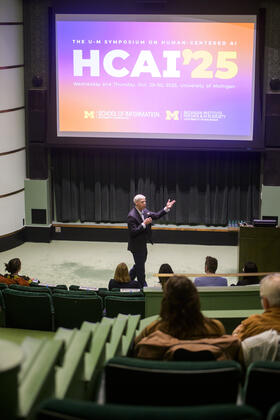
“Are we going to be replacing our professors, our ministers, our friends with AI?” asked Brad Orr, U-M’s associate vice president for natural sciences and engineering, in his opening remarks. He discussed many of the challenges associated with AI, from the energy consumption of AI data centers to job displacement and biased and inaccurate outputs.
“Is it something we control,” Orr posed, “or something that controls us?”
These are the questions the University of Michigan School of Information was built to answer, said Dean Andrea Forte. In 1996, as the internet was poised to transform every aspect of daily life, UMSI’s founding brought together engineers, computer scientists, anthropologists and social scientists, with the understanding that the study of technology requires the study of people.
Forte said we find ourselves now in a similar moment — but with even higher stakes.
“We want to design systems that empower rather than exploit, that earn public trust rather than erode it, that reflect and respect the full range of human experience and belief,” she said. “We want to expand opportunity, advance human health and discovery, and address the environmental consequences of widespread AI adoption.”
Forte emphasized that a human-centered approach to AI is not necessarily optimistic. Rather, it should involve rigorous critique, interrogation of practices and methods, and even resistance.
“So, while it may not be optimistic, I believe it is fundamentally hopeful,” she said. “We're in this because we believe that technologies like AI can do great good for humanity, that that future is one in which humans thrive and reach greater heights of potential along many dimensions. But… it turns out that hope involves a lot of hard work.”
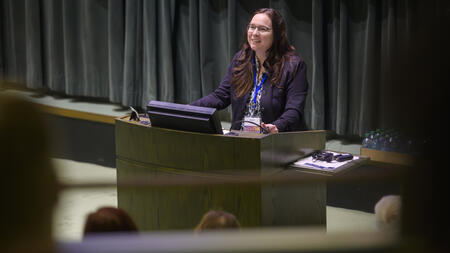
Forte closed her remarks by announcing that UMSI has partnered with MIDAS, Michigan Robotics, and the U-M Schools of Social Work, Law, and Environment and Sustainability to pursue a cluster hire of faculty in human-centered AI. The initiative, supported by the Office of the Provost, reflects an investment in advancing technology that furthers human interests.
The symposium featured eight talks by experts across disciplines and institutions, culminating in a panel discussion.
In her talk, “The Hidden Governance of AI,” UMSI assistant professor and 2024 Microsoft Research AI & Society Fellow Abigail Jacobs examined how technical, political and social goals converge in the development of AI. Jacobs emphasized the importance of making assumptions explicit and measurement processes transparent, noting that once they are institutionalized, faulty assumptions and processes can become invisible.
Jacobs’ approach borrows tools from the social sciences: validity (whether a system is measuring or doing what it’s supposed to) and reliability (whether a measurement produces consistent results over time). She calls these tools generative, because they make systems work better.
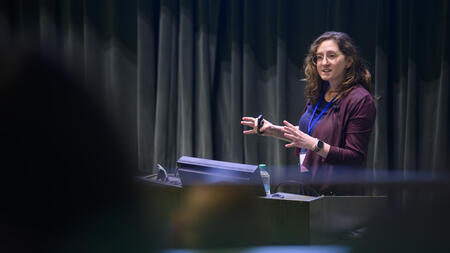
“I don’t see this as impeding innovation,” Jacobs said in response to an audience question. “One of the ways I approach this is, for an engineering audience, ‘Don’t you want your system to do what you say it does?’”
Among the attendees were 20 local high school students from Skyline High School and Huron High School. The students are members of an AI council working with Ann Arbor Public Schools staff to develop a guide for AI ethics and usage in their district.
“What I loved about the symposium were the applications of AI in the workplace and public spaces,” said Avan Zaman, a senior at Huron High School. “In school, we view AI as a tool that is discouraged and promotes plagiarism in coursework. But at the symposium, we saw the applications of AI, including how it can be used to enhance the actions of people, rather than replace their jobs.”
Zaman paid close attention to sessions focused on AI ethics, which for him highlighted the importance of having clear AI policies within schools.
His overall takeaway was hopeful. “It was really intriguing to see how our future careers are evolving, not dissolving,” he said.