
William Warner Bishop (1871-1955)
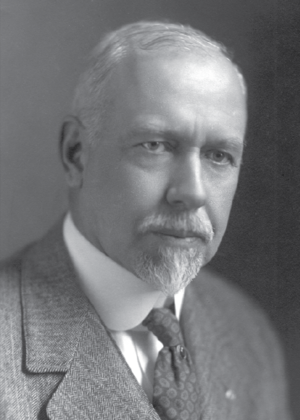
Chair of the University of Michigan Department of Library Science 1926-40
Considered one of the most influential librarians in American history, William Warner Bishop was born in Hannibal, Missouri, in 1871 and spent his early years in Detroit.
He earned an AB from the University of Michigan in 1892 and an AM the following year, beginning his academic career as a professor of Greek at Missouri Wesleyan College. He spent the year of 1898-99 as a fellow at the American School of Classical Studies at Rome, and after his return to the U.S., served as librarian and Latin instructor at the Brooklyn Polytechnic Institute.
Deciding after a few years of teaching that his future belonged in the library rather than a classroom, he moved to Princeton University in 1902 to work as head cataloger. In 1904, he went to the Library of Congress as a reference librarian, becoming superintendent of the reading room in 1907. In 1915, he returned to U-M as university librarian, a position he held until his retirement in 1941.
His career achievements are many. In 1918-19, he was president of the American Library Association. In 1926, he organized the U-M Department of Library Science, the origin of today’s School of Information. As a chief consultant to the Carnegie Corporation, he was invited to aid in organizing the Library of the League of Nations and reorganizing the Vatican Library.
Among his principal interests were the international aspects of librarianship. He made numerous trips to Europe as a delegate, book buyer, lecturer and researcher. In 1925, he was made an honorary member of the Chinese Library Association and in 1937, he was invited to China to survey its libraries and outline a program for their development.
In addition to his many honorary memberships, fellowships and offices, Bishop was awarded eight honorary doctorates by institutions that included Columbia University, the National University of Ireland and New York University. In 1999, American Libraries named him one of the 100 most important library leaders of the 20th century.
In later years, he divided his time between his home in Ann Arbor and his winter retreat in northern Florida, where he wrote fragments of his autobiography. He died on Feb. 19, 1955. The Library Quarterly, which published many of his articles as well as his autobiographical fragments, eulogized him as “a great scholar, an able administrator, a fine bookman and an inspiring teacher.”