
UMSI Alumni Snapshot: Lydia Schrandt

Lydia Schrandt (MADS ’24) spent more than a decade as a travel writer and editor before COVID-19 brought her industry to a standstill. Looking for a new opportunity, she landed at Coursera. There, almost by accident, she fell in love with data science.
Schrandt had never written a line of code when she joined Coursera’s content marketing team. But after taking Python for Everybody — the popular free course developed by UMSI clinical professor Charles Severance — she was convinced she could master a full range of data science skills and put them to work immediately.
That’s when she enrolled in the University of Michigan School of Information’s fully-online Master of Applied Data Science program.
Now a senior manager of organic acquisition at Coursera, Schrandt leads a data-driven marketing strategy — and actively imparts to her team the data analysis, visualization and storytelling expertise she developed in MADS.
“It’s fun to think about the business and to answer data questions every day about what I’m doing and why I’m doing it. It’s a role where I get to learn new things all the time,” Schrandt says. “It’s always changing, especially in search engine optimization right now with generative AI. Every day is a new challenge, and I really like that.”
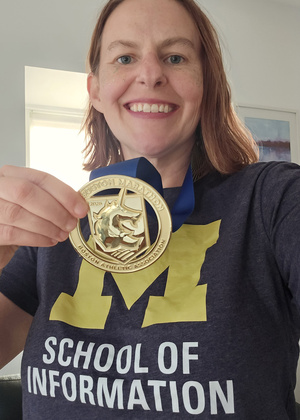
An avid runner with more than 20 marathons and ultramarathons under her belt, Schrandt is taking on the 2026 Boston Marathon with added purpose: running in partnership with the Corey C. Griffin Foundation, which funds educational access and mentorship programs for young people in underserved communities.
In the Q&A below, Schrandt reflects on her winding path to data science, how a non-technical background can be a strength in MADS, and the single course experience that changed how she thinks about data.
UMSI: What is your current position, and what do you do in that position?
Lydia Schrandt: For the last several years, I’ve been working in marketing for the edtech company Coursera. The team that I manage does all of our off-platform growth acquisition: organic social media, YouTube, a little bit of non-Google SEO. I’ve been managing that team, and I’m also managing our influencer program, which is really cool because it gave me a way to take a lot of the things I was learning in the Master of Applied Data Science program and apply them at work almost right away.
How did you learn about the MADS program?
I learned about MADS through work, actually. When I first joined Coursera, I had never written a line of code in my life. I started taking Python for Everybody by Dr. Chuck, who is a University of Michigan professor, and I fell in love with it. Through that program, I realized that he was part of MADS, and I decided that I loved Python enough and I loved data enough — and I needed those skills in my job anyway — that I went for it.
What did you do before you joined Coursera, and how does that experience compare to what you do now?
Before Coursera, I was actually in travel journalism for more than 10 years. I was an editor at USA Today 10Best doing travel coverage. Very different world. I was using a lot more creative writing and photography skills, and very little on the side of data analysis, business, all of that.
When the pandemic hit and the whole travel world shut down, that was the motivation for me to move on and find something else. I think moving to Coursera was a good change. I started out on the content marketing team writing long-form articles. It was such a great learning experience because I had to get up on the business context side of things quickly.
It’s fun to think about the business and to answer data questions every day about what I’m doing and why I’m doing it. It’s a role where I get to learn new things all the time. It’s always changing, especially in SEO right now with GenAI. Every day is a new challenge, and I really like that.
Do you have any updates or milestones that you’d like to share — projects, research, publications?
One of the things that I’ve been working on this year is building some new forecasting models for our social media metrics. That’s been really cool because the space is a little bit more complicated — every platform’s a little bit different and has its own set of metrics and trends. We’re also forecasting against various different internal company metrics. Building out those models and tweaking them to get to the point where our forecast is more and more accurate has been a really fun project.
We’ve also been migrating some of our data reporting tools. We’ve historically used mostly Looker. We’re moving into Databricks and Amplitude. Getting to build out new dashboards to do some of that data storytelling at the executive level has been a fun initiative.
What does a day in your life look like?
I start early — usually about 5 a.m. because it gets hot here — to go out and run. I feel like running has become my one consistent thing. No matter how my day goes, at least I have that crossed off and done. That’s my time. I usually listen to an audiobook while I do that, come back, clean up, and start work.
Throughout the day, it’s a mixture of meetings with my immediate team, my manager, and the data science team, and work on individual projects. Right now, that work involves a lot of dashboarding, forecasting and building out reports for executives about what’s happening in the SEO and social media world.
I wrap up in the early evening. Besides that, I’m pretty involved in the running community around Houston. I try to volunteer when I can. I’m excited to volunteer at the World Cup here this summer. In my free time, I also take pottery classes. I go to a clay studio once a week and let my creativity out that way as well.
How do you apply UMSI skills in your work?
I think Coursera as a company, and the marketing team specifically, are very data-driven. Of what I pulled from the MADS program, one of the things I’m using every day is not only the ability to clean data, but also to contextualize it and communicate it to other people — and I’m teaching those skills to my team.
I have a fairly junior team of, for the most part, social media managers. I’m imparting to them the importance of data, how to think about it, how to structure and experiment so that the results are reliable and make sense, and then tying that into the business. Why do this experiment versus that experiment, based on potential impact?
I think on a very practical level, there are a lot of times where we’ll get a big dataset from a certain social platform or from some kind of SEO project, and I’ve loved having the ability to go in with Python and quickly spin up metrics and higher level views that would’ve taken me a long time to complete via manual analysis in the past. A lot of people on the team don’t have those skills yet, so it’s nice to be able to make processes move faster. Especially now that AI makes code generation so much faster, too, I feel like understanding Python makes it even easier to then go in and use these tools to execute even quicker.
What is your most valuable UMSI experience?
My favorite and one of the most impactful experiences — and the one that stayed with me — was probably one of the early data visualization courses with Dr. Christopher Brooks. I remember the final project: He basically gave us all of his Strava data, so running, cycling, all of that, and just said, “Show me something interesting.” It was this huge packet of pretty messy data. There was no indication of what was biking, what was running. We had to figure out how to clean that and make sense of it ourselves.
And there was just so much possibility of what to do with it. Since it was so applicable to me, also being a runner, I found it really fun, and I liked the open-endedness of it. I thought that was actually a really valuable skill in itself. Given data without a specific question, I had to come up with the questions I wanted to answer that were interesting. That experience shaped how I think about exploratory data analysis, visualization and storytelling with data in my job.
How do you get your foot in the door of a career path after earning a master’s degree?
I feel like my career path has been a series of happy accidents, in a way. When I graduated with my bachelor’s — it was in philosophy, of all things — it was 2006, and we were in the middle of a recession. It was pretty hard to get employed in any format, especially with a philosophy degree. I ended up moving overseas to teach English because I knew somebody doing that and thought, OK, that sounds fun.
Through that, I started travel writing because I was out in the world, traveling a lot. The company I was doing a lot of writing for was acquired by USA Today 10Best. I started editing for them.
Then, when the pandemic hit and travel came to a standstill for a while, that got me onto a different path. I was out there looking for other writing opportunities and landed on something in marketing and edtech that I happened to really love and be passionate about. None of these were things I ever really decided upon. In my childhood, I wouldn’t have chosen any of these paths, but it feels like where I belong now.
Would you like to share one piece of advice for undergraduates and new graduates trying to enter and keep up with the information field?
Don’t be intimidated if you’re not coming from a technical background. I actually found that coming from philosophy and writing, liberal arts, was a strength for me. I was obviously able to learn to code and all the technical stuff, but especially in the capstones and group projects, being able to articulate ideas well and write and present ideas and build stories — those were skills that some of the people coming from really technical backgrounds sometimes struggled with. I could step in like, “I can write all day long if we need to write up a project report. I got it.”
Lean into your strengths, and don’t be afraid of the technical topics. The MADS program is really good at taking you from a very limited background to a professional skillset, and I progressed really well. Chip away at it bit by bit, and don’t be afraid if you’re not as technical when starting out as your classmates from engineering backgrounds.
What inspired you to participate in the Boston Marathon?
I started running during the pandemic because I had been involved in CrossFit and other active hobbies, and I hated running. I decided since all the gyms were closed, I would just see if I could get better at it. Something switched in my head, and I fell in love.
Boston will be my 20th race that’s a marathon or longer. This is the first time I’m running a race in partnership with a charity. It’s been a really cool experience because it’s so much bigger than me or a medal, to be able to raise awareness and money for kids in communities that might not naturally get the same access to education that I had growing up.
My dad was a teacher and I was lucky to be raised surrounded by educators. I was in the public school system and I had really great teachers who cared about me and invested in my success, and they built up my confidence in that way. It’s really special to be able to merge two things that I care about — running and education — in order to hopefully provide those same kinds of opportunities for kids who might not otherwise get them. I think it will make the race a particularly memorable one.
— April 22, 2026