
Leinweber Computer Science and Information Building earns LEED Gold certification

Wednesday, 09/23/2026
By Taylor Haynes for the University Record
The students, faculty and staff who began calling the Leinweber Computer Science and Information Building home last year are learning, teaching and working in one of the University of Michigan’s most energy-efficient new buildings.
Designed to use 30% less energy than a comparable building constructed to standard energy-code requirements, the North Campus building has earned LEED Gold certification.
“The School of Information is built around the idea that technologies should support human needs and values. It’s fitting that our building reflects that mission, too,” said Andrea Forte, dean of the School of Information. “It’s a building designed for community, collaboration and sustainability in everything from the design of our social staircase to the way the building heats, cools and breathes. We see it in action every day here in Leinweber, and LEED Gold confirms it.”
A key part of the building’s sustainability is its all-electric design. Leinweber is U-M’s first all-electric building and the university’s first large building that does not use natural gas for heating.
With the building designed to use less energy, the Hayward Street Geothermal Facility supplies much of its heating and cooling. Constructed alongside the building and completed in 2024, the facility heats and partially cools Leinweber using geoexchange. Together, Leinweber’s energy-efficiency measures, all-electric design and geoexchange system eliminate on-site fossil-fuel use for heating and hot water.
“Geoexchange, often called geothermal, takes advantage of the earth’s steady underground temperature. In the winter, it draws heat from the ground to help warm the building and in the summer, the process is reversed to help cool it,” said Brian Hall, assistant vice president for utilities. “As a result, these systems tend to be more efficient than their fossil-fuel counterparts.”
LEED, or Leadership in Energy and Environmental Design, is a green-building rating system developed by the U.S. Green Building Council. The Leinweber Building was certified under the LEED v4 system for new construction and major renovations.
The building also incorporates features that support its occupants and the surrounding environment. Bird-safe glass covers portions of the exterior, while glass walls inside carry daylight farther into classrooms, offices and shared spaces.
“Our campuses can be powerful proving grounds for the solutions society needs now and in the future,” said Shana Weber, associate vice president for campus sustainability and innovation. “Leinweber gives us an opportunity to put new approaches into practice, learn from how they perform in real-world conditions and use that experience to help shape the campus energy transition at U-M and beyond.”
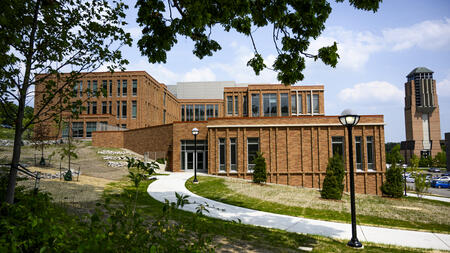
Water use and landscaping were designed with similar goals in mind. Low-flow plumbing fixtures are designed to reduce water consumption by at least 20% beyond Michigan Plumbing Code requirements. Native and drought-tolerant plants were selected for a landscape that does not require permanent irrigation.
Plantings on portions of the second-floor roof help absorb and slow rainwater while providing views of green space from the floors above. Below ground, an infiltration system works with the existing North Campus wetland system near the Art and Architecture Building to manage stormwater from the site.
Project teams also evaluated a structural system combining mass timber with conventional steel and concrete as a way to further reduce the building’s environmental impact. During construction, 72% of construction and demolition waste was diverted from landfills.
“The project makes thoughtful use of a limited site by locating the Hayward geoexchange field beneath an existing surface parking lot,” said Sue Gott, associate director of planning and communication in Architecture, Engineering and Construction. “That efficient use of campus land provides essential infrastructure for the new building while preserving space for teaching, research and collaboration.”
Leinweber sits next to the College of Engineering’s Bob and Betty Beyster Building and is connected to it by a series of passageways. It features five lecture halls with more than 100 seats each, collaborative shared spaces for the School of Information and the Computer Science and Engineering Division, a design lab, and an augmented-reality and virtual-reality lab.
By bringing together faculty and students previously dispersed among several buildings in downtown Ann Arbor, the new facility creates more opportunities for teaching, research and collaboration under one roof. The $145 million project was made possible in part by a $25 million gift from the Leinweber Foundation.
LEED Gold certification adds Leinweber to U-M’s broader efforts to reduce the environmental impact of campus operations. Its connection to the Hayward Street Geothermal Facility also provides a large-scale example of how new buildings and energy infrastructure can work together as the university advances its campus energy transition.