
A vision for the future: UMSI-founded startup brings XR into the real world

Tuesday, 08/18/2026
If you were told about a student who launched a startup just before graduating to pursue an idea he’d come up with two months prior, you would probably picture someone eager and driven — maybe a little frenetic.
Chiao Lin fits the bill. A professor once compared him to a pull-back toy car, the kind that speeds forward with tremendous energy. There was a warning in this, too: If you go too fast, you might run into a wall.
Lin doesn’t let walls deter him, only redirect him.
He grew up in Taiwan, where he studied architecture. Before coming to the University of Michigan School of Information, he worked across website development and e-commerce, sometimes holding multiple jobs at once as he saved money for graduate school.
A scholarship from UMSI made it possible for him to choose the Master of Science in Information program, where he studied user-centered agile development and earned a graduate certificate in extended reality.
Lin says choosing an information school, instead of engineering or computer science, played a key role in shaping his entrepreneurial path.
“This is a lively community where people have different kinds of skills, from psychology to computer science and graphic design,” he says of UMSI. “To make a real product, a product people will use, love and pay for, it takes all these talented people working together with a clear vision.”
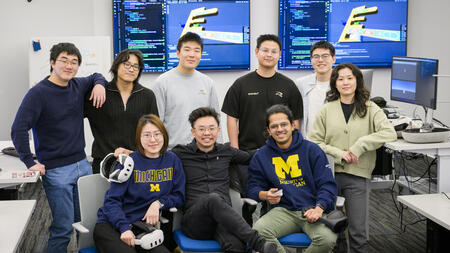
This is the story of the startup he co-founded with another UMSI student, Anhua Wu, which is poised to change how we use extended reality to teach and learn in 3D.
Less than two years after launching, Mixel Studio has grown into an eight-person team, secured multiple investments and entered into an agreement with U-M to bring its patent-pending technology to market.
It’s a story about finding the right problem to solve. And the right people to solve it with.
If it were a movie, it would be called The Last Mile. We’ll get to the reason for that later.
Building blocks
It began one Ann Arbor winter as a passion project.
After competing in MIT’s Reality Hack in January 2024, where his team earned an honorable mention for their block-based coding concept in mixed reality, Lin returned to Michigan and couldn’t stop iterating.
What if the user wasn’t just stacking 3D blocks to learn to code? What if their code could make virtual objects interact with the real world — turning their own surroundings into a coding playground?
With help from classmate Tara Dorje, he presented this new concept at U-M’s James A. Kelly Learning Lever Prize for educational technology, walking away with a $4,000 development award.
Wu enters the story around this time, in a scene fitting for a movie.
She’s sitting in an advanced AR/VR course taught by UMSI associate professor Michael Nebeling as Lin gives a presentation on CodeBloc. She’s intrigued, but she has no idea he plans to keep building it.
Then, a few months later, she learns he spent the summer creating a minimum viable product with two other students through a self-directed internship advised by Nebeling.
Adding their coding skills to the mix: MSI student Vivek Selvaraj and computer science undergraduate Ting Lu. We’ll call them the early squad (cue freeze-frame intros with fun title cards).
She asks to join them.
With an undergraduate degree in computer science from U-M, Wu came to UMSI because of its strength in human-computer interaction. There she pursued a master’s thesis on AR and privacy with Nebeling as her advisor.
She has a strong background in game development, which forms the technical foundation for creating XR experiences. And she has the crucial ability not only to build technology, but to communicate its value to others.
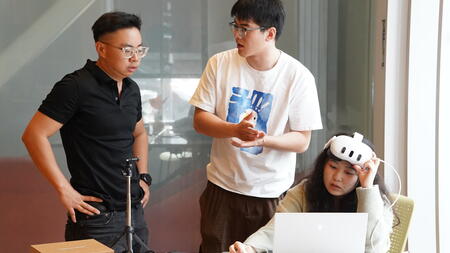
That fall, Lin was starting to think about turning CodeBloc into a company. He was selected as a U-M Zell Entrepreneur, a competitive, yearlong program for students who want to pursue their ventures full time after graduation.
But through all the connections he was making as a Zell Entrepreneur, the advice was the same: To be successful, you have to be solving a problem. You have to give the world something it needs.
A conundrum, and a cute dog
Lin’s problem: He didn’t know what problem he was solving.
CodeBloc offered a new way to teach coding, yes, but children had been learning how to code just fine without it.
In September, the team did user testing with parents and children in Ann Arbor, then began taking CodeBloc into after-school programs, museums and community spaces across Ann Arbor and Detroit to see how children interacted with it.
I attended one of those sessions in March 2025 at the Ann Arbor Hands-On Museum’s annual fundraiser. This time, it was adults — many of them parents — testing it out.
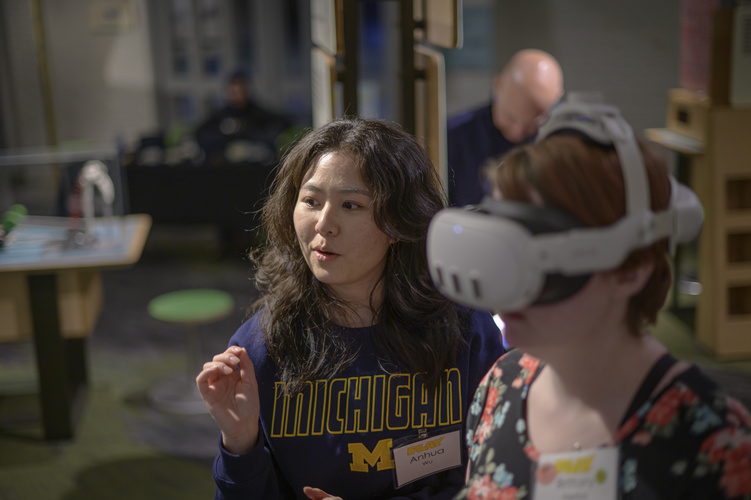
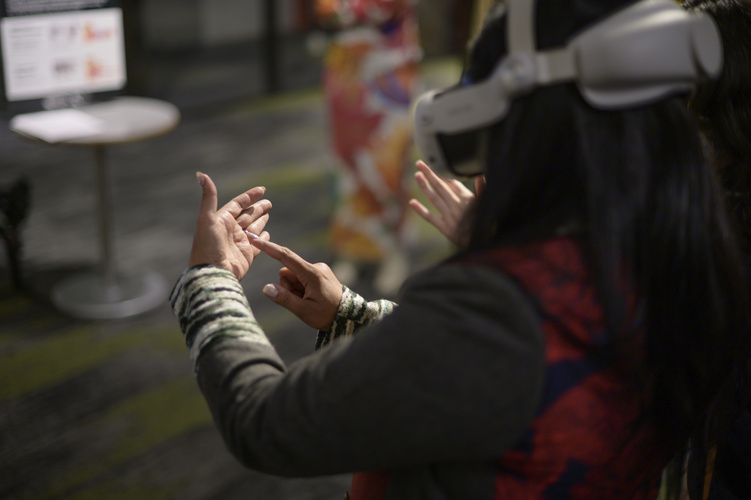
Here’s how it works. You put on the headset and swipe your finger down your palm to open a menu, but nothing happens. Lin gestures to his palm, showing you the correct movement. You try again.
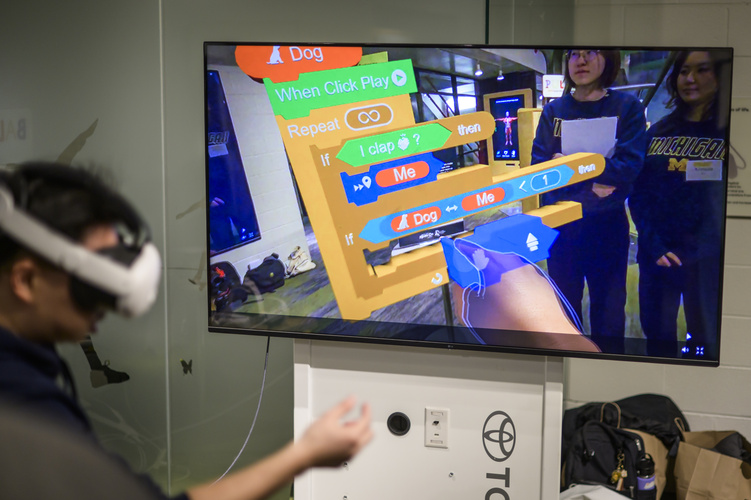
Now, colorful block modules appear in front of you. Lin shows you how to pinch and rearrange them, creating a code sequence. It takes a second to get the hang of it, but your string of commands comes together.
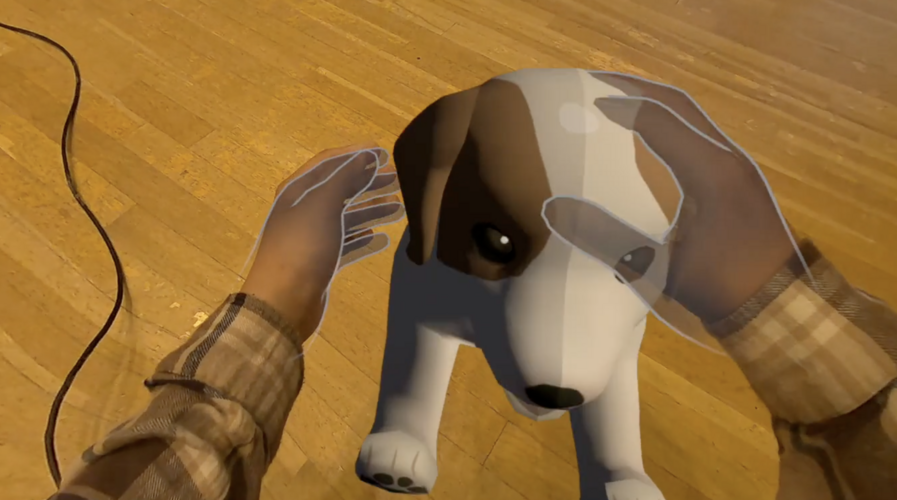
Clap your hands, and a dog approaches.
“You can go up to it,” Lin says. “You can pat its head.” And the dog responds! You actually laugh out loud. For a moment, you’re not thinking about the headset covering your eyes. You’re simply petting a dog.
But now imagine you’re one of 30 students in a classroom.
Lin, giving you one-on-one attention, could guide you seamlessly through this experience. But in demos with large classes, the team struggled to get through all the students in their allotted time.
“When the kid puts on the headset, you wouldn’t necessarily be able to see what they’re seeing,” Wu says. “You pretty much need to have one facilitator per kid to make that experience accessible.”
As he progressed in the Zell Entrepreneurs program, Lin realized the gap that exists between a good idea and a successful venture. By the time he hosted that session at the Hands-On Museum, he was already losing faith in CodeBloc’s ability to scale.
“Schools couldn’t adopt this, not necessarily because they don’t have money for the technology,” Lin says. “Many schools have headsets. The problem is that teachers can’t easily use them for teaching. No one knew how to bring XR into an entire classroom.”
The idea that stuck
Returning home from a large session in Detroit, he started playing with a new idea, one that would solve the problem they were facing.
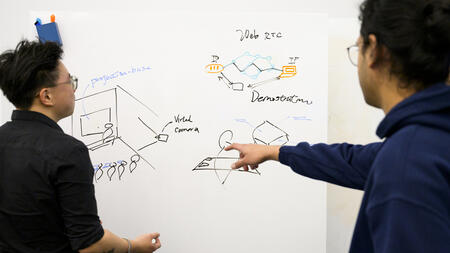
What if an instructor could demonstrate an XR experience to 30 students at once? Lin quickly sketched out the idea, then asked Selvaraj whether he could build a proof of concept to show it was technically possible. Selvaraj said he could.
So, with two weeks left to enter the Learning Lever Prize, Lin began creating a pitch for what would become his startup’s flagship product.
At the time, he was enrolled in a course on XR and education, taught by Rebecca Quintana, clinical associate professor at U-M’s Marsal Family School of Education. She gave him language for what he was working on: classroom orchestration.
Using the platform his team was prototyping, called OXR, a teacher could demonstrate an immersive experience to a class, then move students into small-group or individual activities on their own devices, while retaining real-time control.
In April 2025, Lin and his team presented OXR at the James A. Kelly Learning Lever Prize competition and earned the $10,000 grand prize.
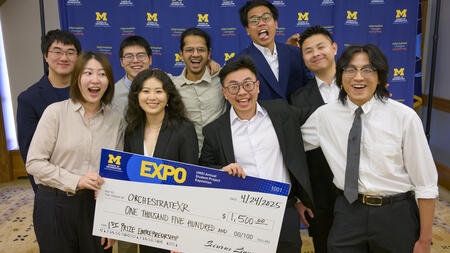
11 days later, OXR earned first prize in the entrepreneurship and innovation category at the UMSI Student Project Exposition.
That same month, Lin incorporated Mixel Studio, where he and Wu would work full time after graduation.
It wasn’t that he had a huge drive to become a CEO, he told me soon after reaching that milestone. “But I think I have the right team, and I think this is the right time.”
He had finally found the right problem to solve.
Ready, set, go
Wu describes that summer in one word: painful.
CodeBloc had been a prototype. OXR had to be a complete product.
She was working full time as a developer, with other recent U-M graduates joining part time. Together, they built the front end, the back end and the cloud infrastructure. Meanwhile, Lin was meeting with potential users and gathering insights to shape the product and business.
This is the movie montage that condenses four months into a series of quick shots: long days, late nights, customer discovery meetings, occasional team dinners over hot pot or tacos. Moments of inspiration and exasperation.
“For many of us, it was the first time building a product from zero to one,” Lin says.
That July, Wu officially became co-founder and chief technology officer of Mixel Studio.
By early October, OXR 1.0 was up and running, and the team took it into the real world, leading demonstrations and pilots in K–12 schools, universities and healthcare settings.
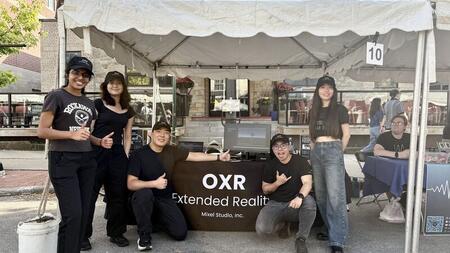
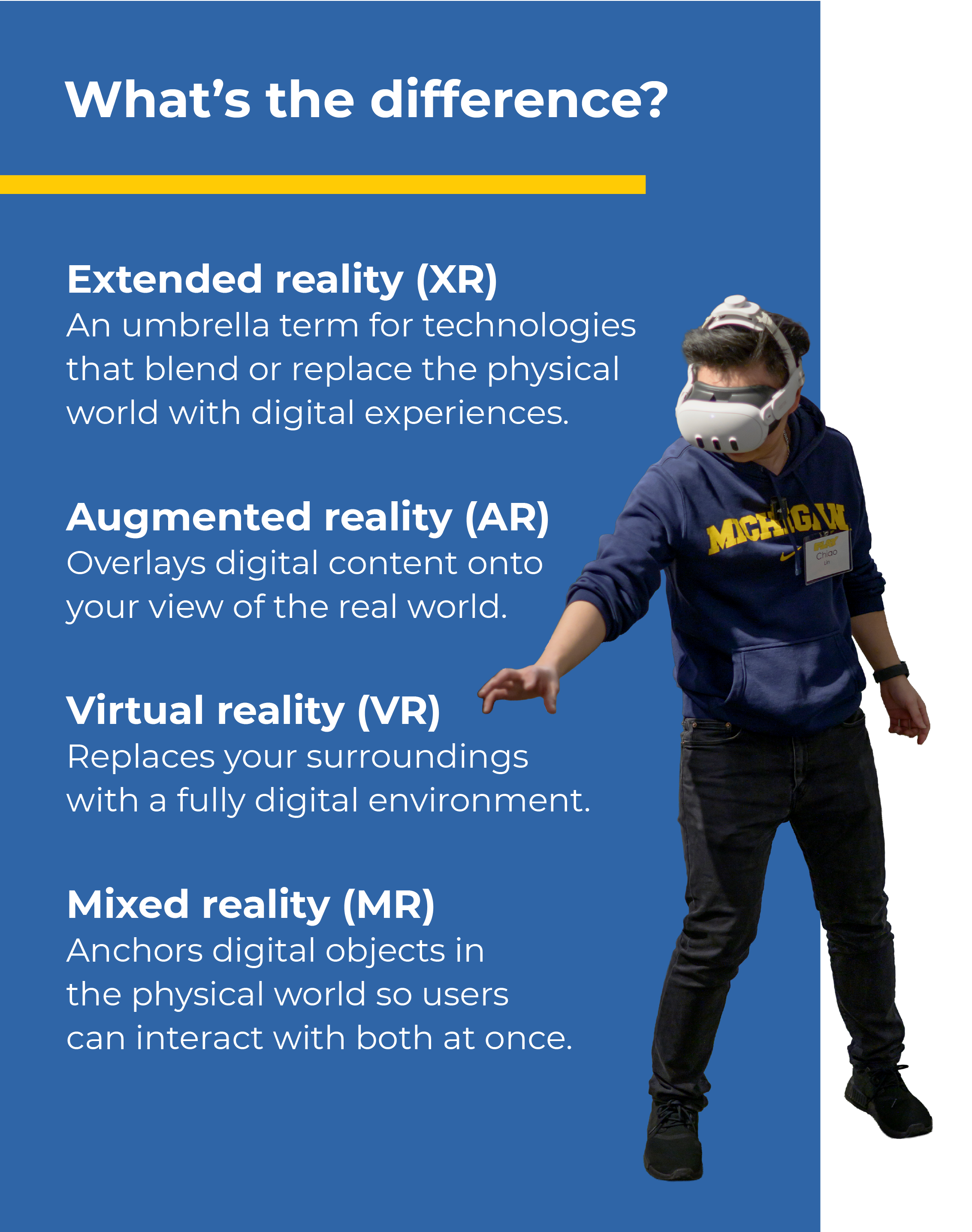
OXR allows users without coding experience to arrange 3D models, images, audio and other materials into spatial presentations. One person can lead the presentation, with an audience following along across multiple devices — not just XR headsets, but web browsers or mobile devices.
Right now, there’s this AI wave. Every startup is looking at building AI, trying to automate tasks. We’re kind of thinking in the opposite direction.
In a full-circle moment, the team brought OXR into Quintana’s class of future learning designers and educators. Every student was able to design and deliver an XR lesson with minimal training, on topics ranging from Turkish coffee making to automotive safety.
“Chiao’s work reflects both entrepreneurial vision and deep attentiveness to educational practice,” Quintana said.
Lin, who struggled early on in his education to learn concepts by reading alone, believes XR can make education more accessible by helping people understand concepts spatially.
But its applications go beyond classroom education.
Say a museum wants to show visitors an artifact that cannot be handled, or a trainer needs to demonstrate equipment to new employees before they enter a lab or factory floor. OXR would allow them to do that.
“Right now, there’s this AI wave. Every startup is looking at building AI, trying to automate tasks,” Wu says. “We’re kind of thinking in the opposite direction. We really want to enhance that human-to-human interaction.”
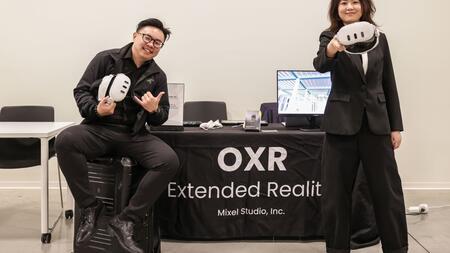
As CTO, Wu shifted into a business mindset: attending demos and meetings, listening for what prospective users needed and translating those insights into development priorities for the team.
“We’re a very, very small team right now,” she says, “and we need to move really, really fast.”
Especially in those early months, when a potential customer asked for a feature that didn’t exist, they would work hard to create it. Pull back the toy car and release.
By winter 2026, outside interest was starting to turn into opportunities.
Mixel Studio was selected as one of five early-stage startups for the Michigan Founders Fund Pre-Accelerator, receiving $15,000 in funding and the opportunity to connect with founders and investors across Ann Arbor and Detroit.
This felt like a turning point. Until then, the company had proudly grown within the U-M ecosystem, where it began.
“Now we are getting recognition beyond that,” Lin said. “That’s a new milestone for us.”
The last mile
In innovation, there’s what is called the first mile. That’s where a lot of XR inventors are focused, Lin says. They’re advancing the technology itself, focusing on haptics, hand tracking, room mapping and other new capabilities.
The last mile is less flashy.
But this is the space where OXR thrives: making sure the technology works for the people it’s meant to serve. “The last-mile delivery is what makes technology accessible and scalable,” he says.
The last mile is where you bring it all home.
Two years after arriving at MIT Reality Hack with little experience in XR, Lin was invited back as a judge.
One year after earning the Learning Lever grand prize, Mixel Studio filed a U.S. provisional patent for the technology that coordinates connected experiences across different devices, with support from the U-M’s Innovation Partnerships.
In July 2026, the company entered an exclusive worldwide licensing agreement with U-M, giving it the right to continue developing and commercializing that university-created technology.
“When we started off, we just wanted to build a tool that people use,” Lin says. “If we were able to deliver a product that is useful to people, to communities, that is a success for us.”
Recently, the company secured an investment from Union Heritage Ventures to advance human-centered spatial computing, following institutional investments from U-M’s Zell Founders Fund and Michigan State University Research Foundation’s Red Cedar Ventures.
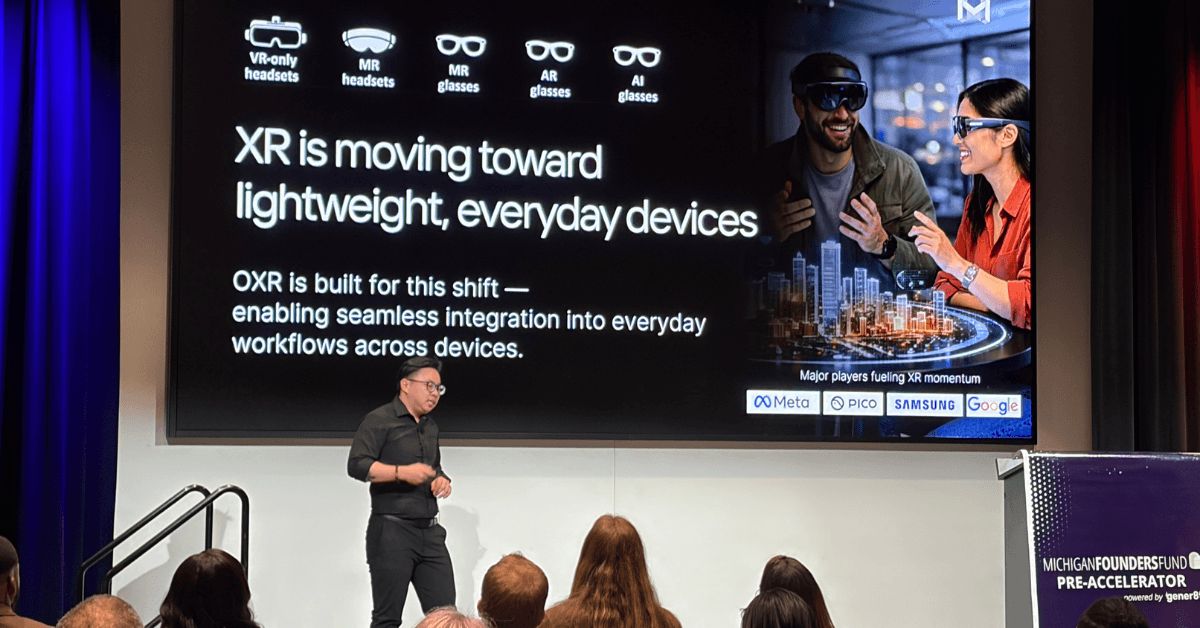
“There are a lot of opportunities out there,” Lin says.
As bulky headsets give way to lightweight AR glasses, Lin and Wu imagine a near future when this technology will cost less, and fold even more seamlessly into how we teach, work and interact.
“We’re building OXR for today,” Wu says, “but our vision extends into the future.”
Photo illustrations by Laura Koroncey