
The school that kept outgrowing its name

Tuesday, 09/08/2026
A student learning to classify books by letter and number under the glow of incandescent bulbs in 1926 could hardly have imagined information traveling as pulses of light through cables strung across the ocean floor — accessible to almost anyone, anywhere, in an instant.
But the library profession was already being transformed by technology in the early 20th century. The advent of elevators and electrical lighting, of structural steel and reinforced concrete, made it possible for the University of Michigan to build a new, larger library in 1920, with the capacity to hold one million volumes.
“Much of our modern theory and practice is due to the engineer and inventor rather than to the librarian,” wrote university librarian William Warner Bishop in 1919, referring to these technologies.

In 1926, U-M created a Department of Library Science, with Bishop as its first chair.
From its origin as a department with three full-time faculty members, the School of Information’s century-long story moves in step with technological turning points. Its history is also the story of how the world’s knowledge came to be stored not only in books but on servers and in databases.
The school’s survival into the 21st century wasn’t a given. From the 1970s through the 1990s, more than a dozen U.S. library and information programs closed their doors amid questions about the field’s future.
But U-M ultimately bet that information professionals were the future, not the past. That rapidly advancing information technologies would require people who understood how these technologies worked, and how to make them useful for people.
Among the faculty who have been drawn to this experimental school are pioneers of the internet, experts on social media and some of the most trusted voices on the societal impact of artificial intelligence.
UMSI’s history is as much about the power of tradition as it is about bold pivots and bucking norms. It shows us what might be possible, and necessary, as we face a technological transformation today that could be the greatest yet.
Not your typical classmates

Among the earliest students were the Vatican’s own librarians, sent to Ann Arbor to learn modern library methods they could bring back to Rome. Their paths crossed with classmates at many different stages of life — most of them women, unlike the broader university in the 1920s.
Some of these aspiring librarians were returning to work after raising children. Others, young and unmarried, had come of age just as women won the right to vote and gained greater access to professional life.
The department was intent not just on training librarians, but on training leaders of libraries. Students received hands-on experience, taking workshops in the bookbinding and cataloging rooms of the university library.
The first class of 31 graduates earned their bachelor’s and master’s degrees in library science in 1927. A year later, the program became the third in the nation accredited by the American Library Association.
The first decade of graduates shaped prestigious college libraries like Swarthmore’s, led research libraries like the John Crerar in Chicago and served their communities at public libraries including Enoch Pratt in Baltimore.
One of those students was Clara Stanton Jones, who graduated in 1938. As director of the Detroit Public Library, she became the first woman and first African American to lead a major public library system in the United States. In 1976, she was elected as the first African American president of the ALA.
I can find that answer for you
Librarianship was part art, part science. Librarians were expected to be experts at systematically organizing and accessing collections. But they also had to understand the needs and interests of their own library’s users, and build collections accordingly.
These skills, both technical and human-centered, would prove to be as relevant in the age of ChatGPT as they were in the age of the card catalog.
The department’s required courses on cataloging, reference and collection building were meant to provide a strong foundation whether graduates pursued careers in public or academic libraries. But under Bishop, the department swayed toward academic librarianship — a point of pride or tension during the school’s first few decades, depending on who was asked.

In 1948, the department went all in on graduate education, ending the bachelor’s degree, continuing its master’s degree and introducing a PhD program.
After World War II, library science programs nationwide entered a new chapter. Federal funding for libraries created greater demand for librarians and explosive growth for library education.
Students’ interests also began shifting toward public libraries and the role librarians could play in their communities. The department responded in 1955 by creating a new summer workshop, “The Librarian as a Community Leader.”
A journal entry from a student in 1962 describes a visit to the Detroit Public Library as a “most interesting tour of one of the world’s largest public libraries,” noting its 14 departments, all fully staffed. That student, Johnnie O. Dent, would build a 45-year career as a public librarian, insisting on always living in the communities where she worked.

During this time, the department’s reputation as a top library science program was cemented. But unlike its peers, it wasn’t yet a school.
Bishop’s first attempt to elevate the department to school status in 1933 had been unsuccessful, in part because he made his move during the Great Depression, when library programs nationwide were under pressure to reduce their enrollments.
Three decades later, that moment finally came. The ALA’s Committee on Accreditation recommended that the department become a school of its own, and the university agreed.
In 1969, the Department of Library Science became the School of Library Science, with alumnus Russell E. Bidlack as its first dean.
Computers and their allied monsters
The department’s first course on using computing technology to handle information was offered in 1953, more as a novelty than a form of practical preparation.
The university built its own computer that same year, one of only 20 high-speed digital computers in the country. Though dedicated to military and defense research, it helped put Michigan at the forefront of academic computing. But the idea of computers becoming central to librarianship still seemed rooted in a far-off future.
In 1969, as the newly minted School of Library Science took a fresh look at its curriculum, that future seemed less distant and the dilemma more pressing.
In open hearings held that year, students called for a required course on computing and data processing for librarians. This represented a paradigm shift for faculty who had built their careers working with physical collections.
“I have been spending considerable time in the past year and a half reading and talking computers and their allied monsters,” Wallace Bonk wrote in a chairman’s report to alumni just before the department became a school, musing about what might be possible using the “strange whirring and flashing deities.”
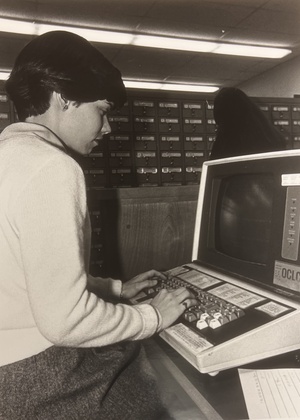
Over the next two decades, those deities turned ordinary, though their power and reach only grew.
Computers became tools for storing, searching and connecting the public with information. A 1980 article in The Michigan Daily, titled “The librarian: A changing role,” describes the students of the university’s smallest school. Far from “persnickety matrons [with an] affinity for quoting Milton,” modern librarians needed to be experts in working with computers.
The school now intended to prepare students for careers beyond librarianship, in technical services, database design, information retrieval and networks.
This list, while still aspirational when it was created by faculty in 1985, marked a crucial shift from seeing the school’s graduates as users of technology to imagining them as designers and developers of technology.
The next year, after former Archivist of the United States Robert M. Warner became dean, the school changed its name again. The new name, the School of Information and Library Studies, reflected a field and curriculum increasingly shaped by information technology.
It was also a field facing increasing pressures. In 1989 and 1992, two of the top library science schools in the country — at the University of Chicago and Columbia University — closed their doors, part of a wave that included at least a dozen more.
But something different was on the horizon for UMSI: serendipity, experimentation and, ultimately, reinvention.
A school with no equivalent
What might have been an unremarkable lunch between two colleagues in 1992 instead set in motion a bold new path for the school.
Warner, who was preparing to retire, asked renowned computer scientist and engineer Daniel E. Atkins if he would consider becoming the next dean. Though initially surprised at the proposal, Atkins describes what followed as “the alignment of the planets.”
He had recently finished his term as interim dean of the College of Engineering and was looking for a new opportunity. For several years, he had also been leading a research team of faculty collaborating across computer science, psychology, economics, library science, space physics and law.
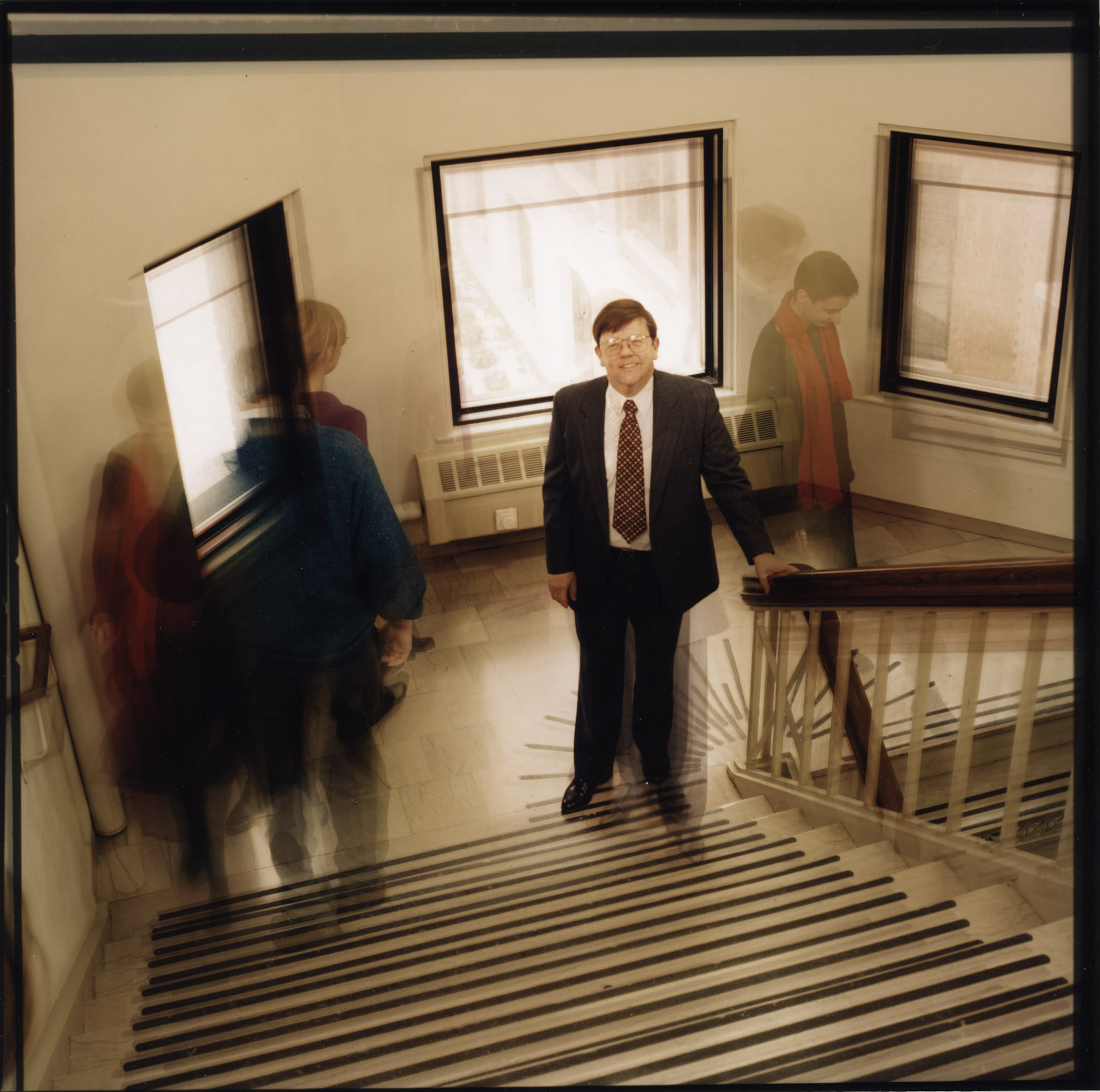
“We started seeing that we needed each other,” he recalls. “We started seeing that we needed a whole new kind of professional, who understood the technical as well as the social and behavioral.”
This group of faculty was looking for a new home, a place where hardware and code would not be studied in isolation from people and society.
Meanwhile, the W.K. Kellogg Foundation approached U-M’s president, James Duderstadt, with the offer of a major grant if U-M would lead the way in producing the next generation of information professionals. As Atkins puts it, they wanted to ensure the digital age wouldn’t be left solely in the hands of “the pure techies.”
In 1994, two years into his term as dean, the school was awarded $4.3 million to reinvent itself for the 21st century.
Atkins found a key partner in C. Olivia Frost, associate dean for academic affairs and an early adopter of digitization technologies. She served as a bridge between the school’s emerging direction and its library science tradition.
This new endeavor would need a new name. At first, faculty and leadership tried tacking descriptors onto the existing name, which quickly grew long-winded. Finally, they took the opposite approach — chipping away until they had just one word that connected the school’s history, present and future.
Atkins recalls the response of other U-M deans when he shopped the name around as a condition of the Regents’ approval. “If you’re the School of Information,” some joked, “then what’s left for the rest of us?”

In 1996, the University of Michigan School of Information was officially born. Its aim was to extend librarianship’s rich traditions of service and information access into the digital age, and to prepare students for careers that didn’t yet exist.
Scaffolding the abyss
The faculty were all given denim work shirts with the school’s new logo, and a gargantuan task: not only to combine their interests, but to define a new curriculum.
They rolled up their sleeves and got to work.
Instead of haphazardly stapling together their specialties, they sought to find the underlying connections between fields like library science, computer science, psychology and economics.
In a later retelling, Dean John L. King and Associate Dean George Furnas described the effort to trace those connections that could easily dissolve into nothing, or everything — while resisting the pull of forming separate academic pillars — as “scaffolding the abyss.”
“I was sure something really good was going to come out of it,” Atkins says. “That we were going to make it to the top of Everest.”

When it first launched, the curriculum for the Master of Science in Information program featured specializations in human-computer interaction, library and information services, and archives and records management, with shared core courses.
It emphasized learning through real-world projects, as UMSI does today. A Practical Engagement Program funded by Kellogg would require students to apply their skills to information problems outside the classroom.
In an unexpected turn, the ALA invited the school to submit the entire degree for accreditation, not just its library and information services specialization. This marked a first for the association, and signaled its broadening view of the field.
From UMSI’s collaborations and classrooms near the turn of the 21st century came the first Internet Public Library, which started as a course project; the foundational work that paved the way for JSTOR; and the seminal book on information architecture, written by two recent graduates.
The school embraced its status as renegade: small, agile and resistant to traditional academic borders. In what feels like a symbol of the era, a student prom in 2001 included a drawing for a ride on Dean John L. King’s Harley.
Under King’s leadership, UMSI joined a group of five information schools that met periodically to share emerging insights. In 2005, that multiplying group formally became the iSchools organization.
As the field of information science grew, so did the school.
UMSI launched a Master of Health Informatics program in 2012, as healthcare was being transformed by digitization. In 2014, the Bachelor of Science in Information became the school’s first undergraduate degree in 66 years.
“When I learned of plans to launch the BSI, I felt that I had chosen the right university,” says Mark Gurman, a leading tech journalist and member of the first graduating class. “There was finally a school with classes dedicated to people like me.”
And in 2019, UMSI created one of the university’s first fully online degrees, the Master of Applied Data Science, which quickly became one of its largest programs. A Vatican librarian could now feasibly study at UMSI without leaving Rome.
Sounds like science fiction
A century after the first students arrived to study librarianship, UMSI is now the fourth-largest of the university’s 19 schools and colleges.

Its students design and build digital experiences, make sense of complex data, create AI tools, develop new products and find novel ways to preserve cultural heritage.
Their expertise takes them to Fortune 500 technology companies and leadership roles across industries, from finance and consulting to healthcare and gaming.
Today’s alumni working in libraries include the senior innovation specialist at the Library of Congress and the director of the Los Angeles Public Library. Those who become archivists now preserve not only papers and photographs but email and websites. They use computational tools to organize and provide access to collections at unprecedented scale.
Increasingly, new graduates take on titles like human-centered product manager and generative AI analyst. But the work they do — making information accessible to people — isn’t so different from the school’s roots.
“After negotiations with users to discern their needs, librarians fence in and provide easy access to vast fields of knowledge,” wrote UMSI professor Robert L. Frost in his 2001 history of the school. “Whether that knowledge is held in bound volumes, printed maps, microfilms or databases matters little: the function survives.”
In 2025, the school that had always been outgrowing itself — whether in name, curriculum or quarters — moved into its largest home yet.
The opening of the Leinweber Computer Science and Information Building, made possible by a $25 million gift from the Leinweber Foundation, created a hub for innovation in information and computer science. It features a physical bridge connecting UMSI to the Computer Science and Engineering Division.

That fall, UMSI launched a new undergraduate minor in human-centered AI. Students from any major can now learn to use AI ethically and effectively in their chosen fields, from faculty who have been researching and developing AI for decades.
“AI is fundamentally changing not only the ways we access information, but the ways that information is created,” says Andrea Forte, a social computing scholar who became dean of UMSI in 2024.
When plausible answers to any question can be generated and shared in seconds, how do we know what information is true? If we can’t trust the information available to us, how do we make decisions about our health, about who to elect?
“Those are civilization-defining problems,” Forte says. “And those are the questions that we’re here to answer.”
She believes the school’s strength, throughout its history, has been its agility. But that agility isn’t about chasing new technologies. It’s about staying grounded in the values and practices that endure amid changing technologies.
A student learning to classify books in 1926 couldn’t have pictured our world today. But the same is true now, of us, as we try to envision the next century.
“Whatever the challenges are that we’ll be facing in 50 or 100 years in the realm of information,” Forte says, “they would seem like science fiction to us sitting here right now.”
READ MORE
Visit the UMSI centennial page to explore a timeline of the school’s history and share your memories.