
UMSI partners with Michigan Department of State to expand access to campaign finance data

Friday, 11/21/2025
The money behind politics is a matter of public interest. Campaign finances shape a candidate’s visibility and capacity for outreach — from ad placements to staff — with the potential to influence who gets elected.
But even though this data is disclosed to the public by law, it isn’t always easy to understand. This challenge was the focus of the University of Michigan School of Information’s annual A2 Data Dive, a one-day data hackathon that brings together U-M students, peers from nearby universities and Ann Arbor community members to analyze datasets and find civic solutions.
This year, UMSI partnered with the Michigan Department of State to focus on real campaign finance data from Michigan elections, with the goal of making this data easier for the public to navigate.
"Transparent and accessible campaign finance data is important because it helps voters understand where money is coming from in campaigns, how it is being spent and how it could potentially influence election outcomes,” says Maggie Brodbeck, data science programs manager at UMSI. “Participants had the opportunity to dive into real data that impacts Michigan residents and help empower informed decisions in their own communities."
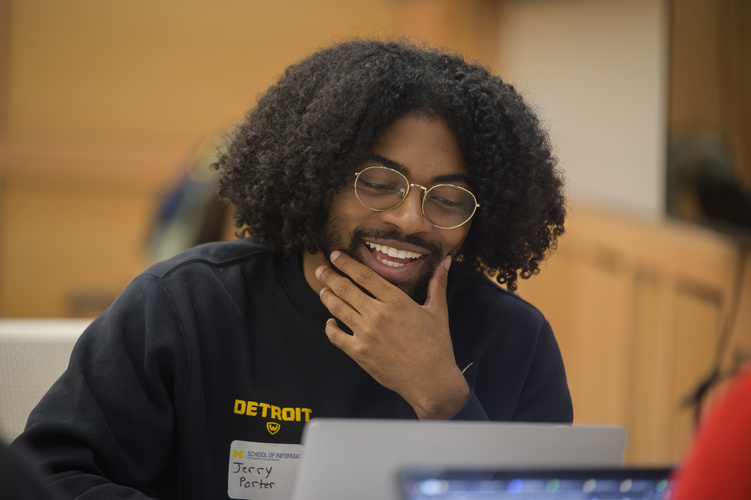
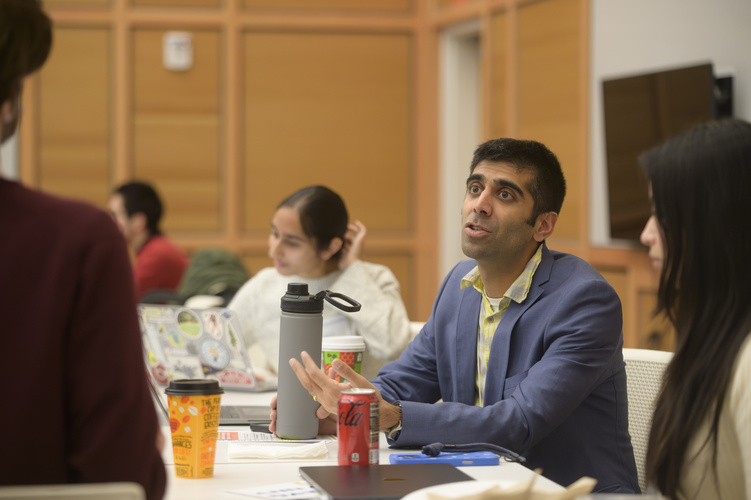
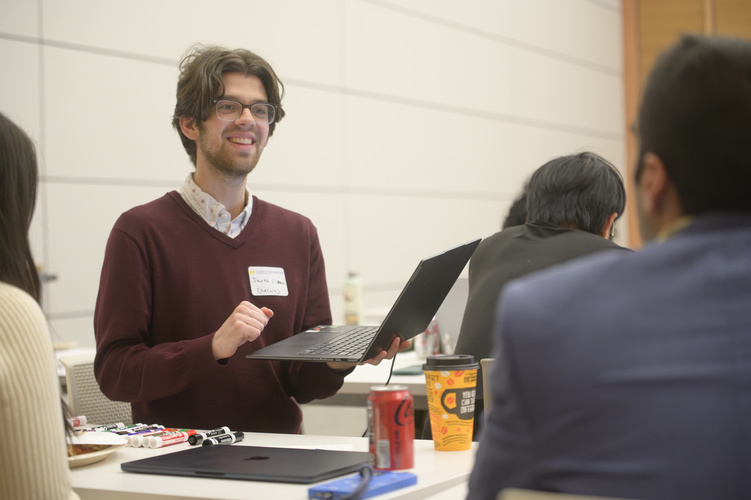
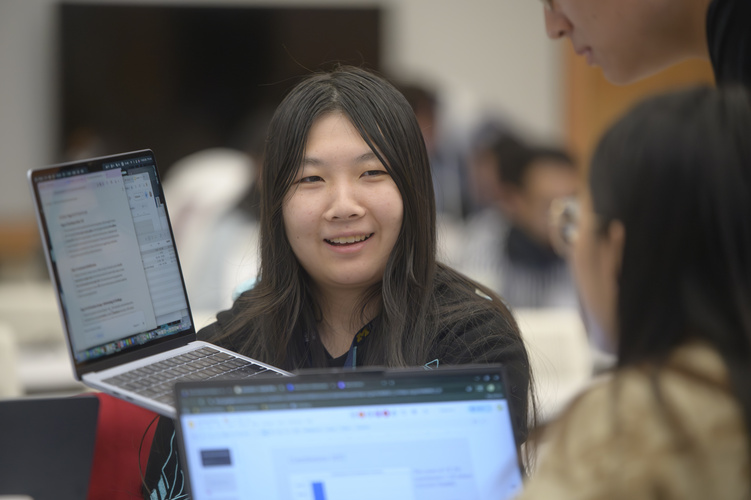
Master of Science in Information student Merrila Liu and Master of Applied Data Science student Luciana Qu led this year’s A2 Data Dive. Among the 55 participants were UMSI students from nearly every degree program, Ann Arbor community members, UMSI alumni and faculty, students from Wayne State University and students from other U-M colleges.
They spent a full Saturday, from 9 a.m. to 5 p.m., collaborating in teams to analyze data and share their findings. Teams were divided into three tracks: Track 1 focused on identifying who gave, how much and when; Track 2 focused on trends across geographical regions and industries; and Track 3 focused on how donor networks and the flow of money drive political influence.
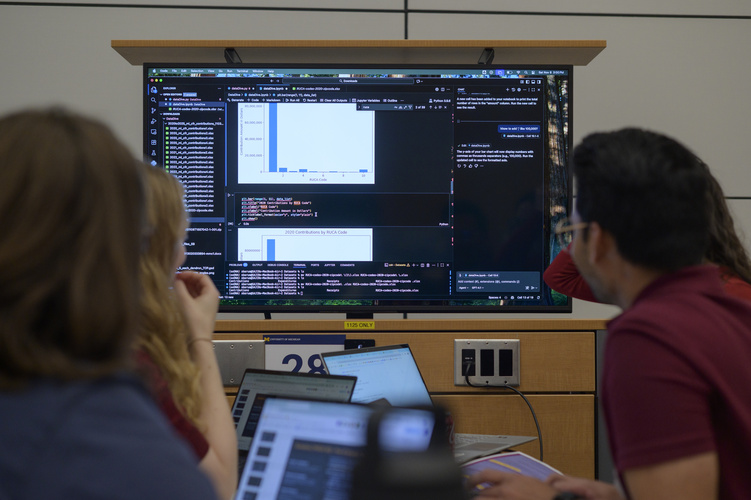
“The time went by super fast,” says Alexandra Schweid, a first-year MSI student on the user-centered agile development track, who worked on a team with two library science and archives students and a PhD student in chemical engineering. They chose to analyze contribution data from 2020, comparing how donation totals varied between urban, suburban and rural areas.
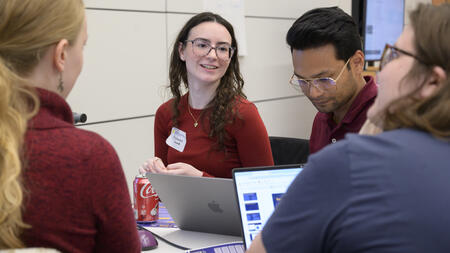
“Our team found an external data set of rural-urban commuting area codes to cross-reference, so we could classify every donation as urban, suburban or rural,” Schweid explains. Their findings might surprise some Michigan residents: While urban areas accounted for the bulk of contributions (~$93 million), rural areas came in second (~8.4 million) — with suburban areas contributing the least (~$5.8 million).
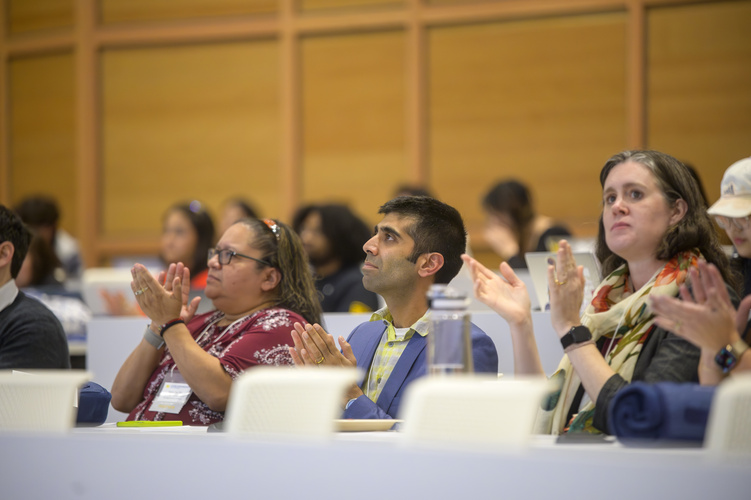
At the end of the day, the teams presented to a panel of judges from the Michigan Department of State, including Neil Tambe (BA ’09, MBA ’15), deputy chief of staff for Michigan Secretary of State Jocelyn Benson.
“The Michigan Department of State values transparency, because a government that's transparent to the people works better for the people,” Tambe says.
Currently, the Michigan Department of State provides campaign finance disclosure data on a public webpage, along with a video tutorial on how to search it. While the tool is useful for those who know what to look for and which filters to apply, it might be intimidating for the average user.
Tambe says partnering with UMSI was valuable because the teams’ presentations “sparked creative ideas for making campaign finance data more accessible for all Michiganders.”
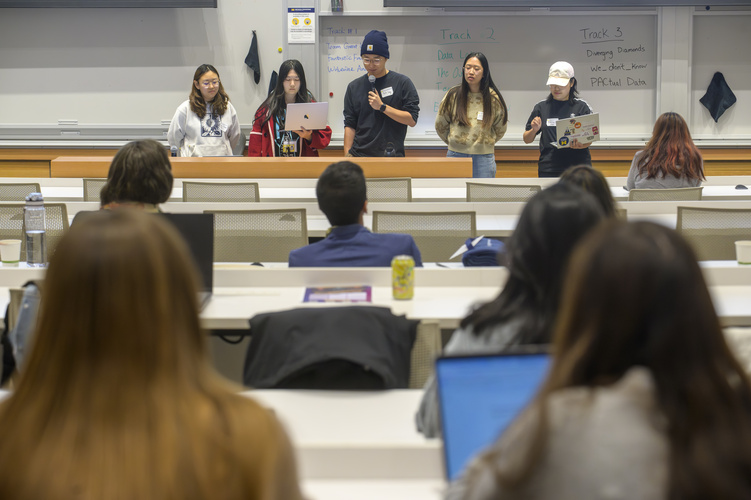
The first-place team in Track 1 — all MSI students — looked at Michigan’s most recent campaign finance cycle to identify the top donors and highest-raising candidates. Using Python and interactive visualizations, they compared total receipts, donation sizes, donor types and timing of contributions. They uncovered heavy reliance on large-dollar contributions and PACs.
In Track 2, the first-place team of MSI and MADS students visualized how campaign contributions and expenditures move across Michigan counties. Their analysis showed clear variation in how much each county receives and spends.
The impact of donor networks on legislative outcomes was the focus for the winning team in Track 3, made up of a BSI student and an undergraduate engineering student. Combining campaign finance data with bill information from the LegiScan API, they explored connections between donor priorities and legislative actions, asking whether donations might spike before key votes.
“We were impressed by what the students accomplished in just one day,” Tambe says. “Their work provided us with many examples of how to make the data we already disclose to the public more relevant, available and easy to use."