
DS/CSS Seminar: Andrew Guess
Does Social Influence Shape Online Political Expression?
Abstract:
Expressing opinions on social media has become a standard form of participation in the political process, but we know little about the factors that shape it. In this paper, we investigate the role of social context. Decades after the development of the canonical "Spiral of Silence" model, the public sphere has radically shifted toward a networked space mediated by social platforms. We articulate a theory of social influence in social media expression and test it by analyzing unique datasets linking U.S. survey respondents to their public Twitter accounts. To measure political expression, we develop and validate a supervised classifier of tweet-level ideology and apply it to respondents' tweets and the tweets of people they follow. We find that the ideology of Twitter followees' tweets is predictive of respondents' own expressed ideology on Twitter, even after holding constant self-reported ideological predispositions. Our findings demonstrate a powerful methodological approach for studying these dynamics.
Speaker Bio:
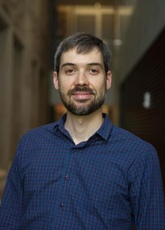
Andy Guess (Ph.D. Columbia University) is an assistant professor of politics and public affairs at Princeton University. His research and teaching interests lie at the intersection of political communication, public opinion, and political behavior.
Via a combination of experimental methods, large datasets, machine learning, and innovative measurement, he studies how people choose, process, spread, and respond to information about politics. Recent work investigates the extent to which online Americans' news habits are polarized (the popular "echo chambers" hypothesis), patterns in the consumption and spread of online misinformation, and the effectiveness of efforts to counteract misperceptions encountered on social media. Coverage of these findings has appeared in The New York Times, The New Yorker, Slate, The Chronicle of Higher Education, and other publications.
His research has been supported by grants from the Volkswagen Foundation, Russell Sage Foundation, and the American Press Institute and published in peer-reviewed journals such as the American Journal of Political Science, Journal of Politics, and Political Analysis.
The University of Michigan Data Science / Computational Social Science faculty host a seminar series that features invited talks, research presentations and informal work-in-progress discussions. A list of the scheduled speakers for Winter 2021 (January-April) is available here.