
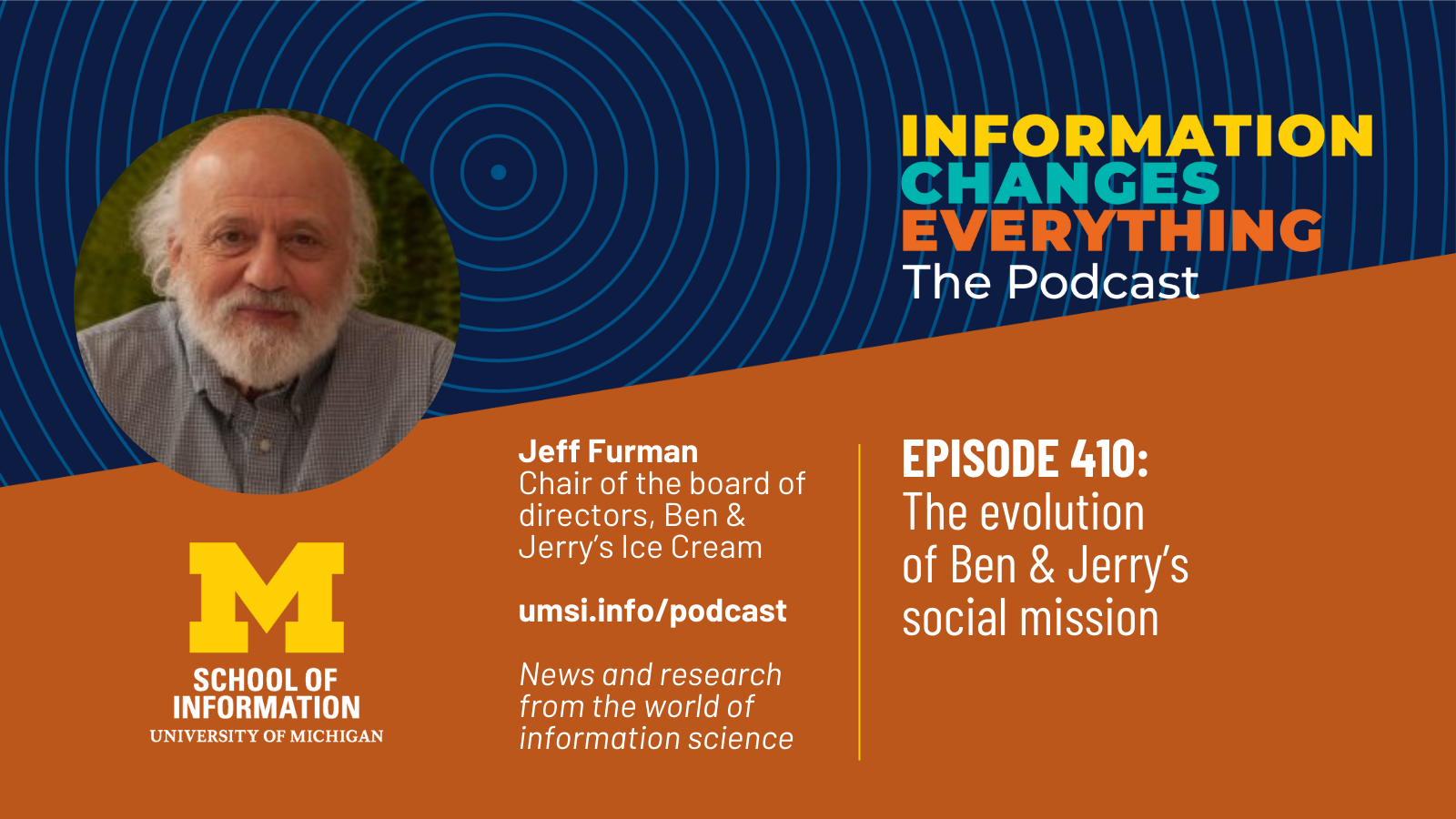
410: Jeff Furman on the evolution of Ben & Jerry's social mission
Listen to UMSI on:
Information Changes Everything
News and research from the world of information science
Presented by the University of Michigan School of Information (UMSI)
Episode
410
Released
July 23, 2024
Recorded
2014
Guests
Jeff Furman is president of the Ben & Jerry’s Foundation.
When this talk was recorded, Furman was chair of the board of directors of Ben & Jerry’s Ice Cream.
Summary
In this episode of “Information Changes Everything,” we put the spotlight on Jeff Furman, chair of the board of Ben & Jerry’s Ice Cream. Join us as Furman takes us back to the early days of Ben & Jerry’s in the 1980s, sharing how the company’s humble beginnings evolved into a powerful social mission. This mission has propelled Ben & Jerry’s to the forefront of socially responsible business practices. Celebrating Ben & Jerry’s 35th anniversary, Furman provides insights into the company’s journey and its ongoing commitment to making a positive impact.
Resources and links mentioned
- Full video of Jeff Furman’s talk on YouTube
- UMSI community mourns the passing of distinguished alumna Nancy Gwinn
- Faces of UMSI: Rachael Zuppke
- AI's Energy Appetite: Meeting The Demand For Innovation | Forbes
- umsi.info/events
Reach out to us at [email protected].
Timestamps
Intro (0:00)
Information news from UMSI (1:45)
Hear excerpts from Jeff Furman’s 2014 guest lecture at the University of Michigan (3:38)
Next time: Transforming education through AI with Dora Demszky (23:38)
Outro (24:48)
Subscribe
Subscribe to “Information Changes Everything” on your favorite podcast platform for more intriguing discussions and expert insights.
About us
The “Information Changes Everything” podcast is a service of the University of Michigan School of Information, leaders and best in research and education for applied data science, information analysis, user experience, data analytics, digital curation, libraries, health informatics and the full field of information science. Visit us at si.umich.edu.
Questions or comments
If you have questions, comments, or topics you'd like us to cover, please reach out to us at [email protected].
Jeff Furman (00:00):
In 1977, both of us left the school. Ben and Jerry wanted to open up an ice cream parlor in Vermont because I had a degree in business, they thought I would be their business advisor and just as a friend, they asked me to help them write a business plan. And so actually to write the business plan, since I had never done one, I got hold of a business plan for a pizza parlor, and the three of us sat around the table, whiting out the word pizza and putting in ice cream. Number of slices became number of cones and ovens became freezers, and this was the start of the whole adventure.
Kate Atkins, host (00:45):
That was Jeff Furman, chair of the board of Ben and Jerry's ice cream during a 2014 talk sponsored by UMSI. And this is information changes everything where we put the spotlight on news and research from the world of information science. You're going to hear from experts, students, researchers, and other people making a real difference. As always, we're presented by the University of Michigan School of Information, UMSI for short. Learn more about us at si.umich.edu. I'm your host, Kate Atkins. Today we'll hear more from Jeff Furman as he describes the early days of Ben and Jerry's in the 1980s and how a desire to give away ice cream and have fun community events evolved into a dynamic social mission with actions that propelled the company into being a leader in socially responsible business. This talk coincided with Ben and Jerry's 35th year anniversary. Before we jump in, a few other people and projects that you should know about.
(01:50):
First, let's take a moment to remember the life of distinguished UMSI alumna Dr. Nancy E. Gwinn. She was the former director of Smithsonian Libraries and an extraordinary leader in international librarianship and library preservation. At the Smithsonian, she launched the library's exhibition program, many fundraising initiatives and expanded rare book collections. She was a Fulbright scholar and award-winning author, and also helped establish the biodiversity heritage library. Gwinn will long be remembered and celebrated for her dedication. Next UMSI Masters candidate Rachael Zuppke specializes in user experience research. After 15 years in nonprofits and a stint at Legal Services of South Central Michigan, she realized that technological barriers hindered her client's access to vital services. Now she's bridging gaps in the design of government services. Awarded funding from anti-Racist Digital Institute, Zuppke’s project is called Empowering Tenants and aims to improve tenant-landlord relations through technology. Finally, while we are all having fun using AI for photo editing, ChatGPT and self-driving cars, it's important to take a moment to realize just how much energy this genie uses and is predicted to need. Forbes, for example, notes that each data center requires the power of a small city and that AI currently accounts for 1.5% of the world's electricity use. For more on all of these stories, check out si.umich.edu or click the link in our show notes. Now back to Jeff Furman.
Jeff Furman (03:41):
We're using the word 35 years. Seems like a lot. That's when I first met Ben actually close to 40 years ago he and I were at a school for struggling and unruly teens. Now, I must tell you quite clearly that we were staff at that school. We were not the teens, although many people said they couldn't really tell the difference, but Ben taught arts and crafts and I was hired as the bus driver of the school of 25 students in the Adirondack Mountains. I had a business degree and a law degree at that time, and I had to call my parents and tell them this was the career path that I was on accepting this bus drivership up in the Adirondack Mountains where we got paid $200 a month. In 1977, both of us left the school. Ben and Jerry wanted to open up an ice cream parlor in Vermont because I had a degree in business, they thought I would be their business advisor.
(04:47):
And as just as a friend, they asked me to help them write a business plan. And so actually to write the business plan, since I had never done one, I got hold of a business plan for a pizza parlor. And the three of us sat around the table, whiting out the word pizza, and putting an ice cream number of slices became number of cones and ovens became freezers, and this was the start of the whole adventure. We also had no business experience, no knowledge on how to make ice cream. And as Carl said, they took a correspondence course at Penn State to learn how to make ice cream. They spent $5 on it. They were very happy that they both got A's. And they also very always like to say that they split the cost of the correspondence course $2 and 50 cents each. We had no connection to the community.
(05:45):
We opened up the ice cream shop in a cold climate and Ben became the head of flavor development and he has a very poor sense of smell. So I don't know if there's a group of you here from the business school, but if you put all those things together and try to say, what are the chances that 35 years later we would still be in business? I would say the chances would be pretty small and pretty amazing. But that's what we put together. No knowledge of business, no idea how to do any of this stuff, but just this kind of commitment to have fun and just have one ice cream parlor. There was also no articulation of a social mission or being mission-driven or ever having heard terms like social entrepreneurship or a corporate responsibility or double bottom line. Those terms were really not in our language.
(06:40):
Back in the late seventies, there was no vision of being big, just the idea of one ice cream store struggling along. And after a few years, we started to sell some pints to some local grocery stores and to sell some ice cream to restaurants. And in the early eighties, they had both Ben and Jerry had continued to just work in the store and they were getting pretty kind of burnt out about this whole thing and trying to think about whether they really wanted to be businessmen for the rest of their lives. We actually had to close the store down one day because, and they put a big sign there, they said, we've closed down because we're trying to figure out what we're doing. Sorry, we'll be open tomorrow. And so in the early eighties, the company which was very small at the time, was put up for sale.
(07:32):
And both Ben and Jerry decided to sell it. And then Ben went through a real personal struggle about selling it and a lot of soul searching and finally decided to keep it and run it as he and it turns out we were good friends and still are thought a business should be run. And we had the advantage of not knowing what we were doing and no real business experience and very little resources. And so we were ready to try anything if we felt in our hearts it was the right thing to do. And the first thing we did once Ben decided to keep it, and then I became quite involved with it and Jerry was still around. He hadn't left completely, but we arranged to have him receive some funds for the part that he had for the company. The first thing we did was decide to sell part of the store to Vermonters and let them own the store.
(08:27):
And then we went to lawyers and had to do this whole offering. All the lawyers informed us that you couldn't do this until we found a very small little thing that says you could do this intrastate offering. And they told us then it would never work. We priced the shares very low so that people could buy 'em. We were told that it was not cost effective and we did it anyway and we sold out and became owned by 3000 Vermonters who became very loyal to the company we were their company one in which all of them took a great deal of pride in owning a small piece of, and as a gift to the Vermonters for buying into our company, we built the world's largest ice cream sundae and put it in an outdoor swimming pool and just people should know, we did manage to remember to take the water out before we put it in, but we had, it was a 27,000 pound ice cream sundae, almost 14 tons of ice cream with whipped cream put in by big trucks and cherries.
(09:30):
And we served the entire state of Vermont. We did it on April 15th, which is tax day so that people could celebrate it. And it was our first gift to our owners, to our Vermonters. And then we decided we were going to continue to do operate the company from a very strong social mission perspective. We launched a peace effort, which included Peace pops 1% for peace on travel to the former Soviet Union to promote cross-cultural exchanges by opening shops there. I made about 30 trips to the Soviet Union and went through a lot of adventures and finally opened up some shops in the northern part of the Soviet Union and began to promote cross-cultural exchanges between folks from the United States and the Soviet Union, including exchanges with young people who were scoopers in our shops. And way before there was any same-sex marriage initiatives, we established a domestic partner health insurance plan.
(10:32):
We set up an onsite childcare facility and took some of our employees to stand in solidarity with indigenous folks to help protect the land, which was taken being taken over by power companies. And we brought our employees up to Quebec to do that. Ironically, we were honored by President Reagan as the best small business in the US and Ben and Jerry actually went and met the president. And the thing that they remember about one, first Ben had an Italian waiter jacket on because he didn't have a sport coat, and he was told that this is the President's show, so be quiet. But the president honored us as the best small business in the United States. And the timing of it was very interesting in that we're just two weeks shy of launching this major 1% for peace initiative, which was an initiative to try to get 1% of the defense department's budget allocated to a peace through understanding.
(11:33):
And we employed a lot of businesses and got a lot of businesses to support this effort. We began that and we began to realize that we had a forum, a place, a platform to continue to push a social agenda. And what amazed us also at that time is that we were economically successful. Our ice cream plant was running marathon shifts to keep up with the demand. It was quite a heady ride during that time as we were growing and realizing that we had power in our voice and that many, many people, consumers, and folks really were craving for a company that they could relate to. And people started to ask us about what our values were, how do we express our values? And as I said before, when we started the company, we really did not talk about the values. We just started to live them.
(12:27):
It became first an attempt. We said, well, a business has a responsibility to give back to the community. And then from that, we started the Ben and Jerry's Foundation to continue the idea of philanthropy. We set up the foundation that gave away seven and a half percent of our pre-tax profits, which was by far the highest amount of any publicly held company in the world at that time. Even we were giving away a small amount of money, but it was still a very high percentage. And our shareholders were quite supportive of it. And then we realized, well, who makes the decision where the money goes? And we decided that it would be the men and women who worked in our plants, those who really worked hard to make the ice cream. And they are still the decision makers of where that money goes here 30 years later from when we originally set it up.
(13:18):
And Jerry and I are both trustees of the foundation, but we like to refer to ourselves as rubber stamps. And over the last 30 years, we have never changed a grant that the folks from the plants are making. But then we came to another place of understanding that philanthropy really wasn't enough. It was how we ran the business day to day that meant something to the world and gave us the power because the money we were spending for supplies and for other things was way more important and bigger and more powerful than giving out money at the end of the day. And we also started to think about every decision, what is the community impact? How does it impact every place where we do business? And we are still doing that around the world now. We are in close to 30 countries and every time we enter a country, we enter equally with a social mission as well as the economic mission of trying to figure out what we do.
(14:19):
But the struggle to maintain our identity has always been a very, very difficult thing for us because there's a dynamic tension between earning money and the social mission and we continue to argue about what's important. Eventually, we put together our three-part social mission, and now the social mission we make sure has a seat at the table on every decision that we make. And of course, from my perspective, and for my little bit of legal training, I like to use the term that while they're all equal, the social mission is the first among equals. But that's just a personal bias and that's just an opinion that what really makes us different is the social mission of the company. But we believe this is how a business has to be run. We believe businesses are the major depositories and bestows of wealth on our planet. We believe with all this power, there is no way business can abandon its responsibilities to engage with our most pressing global issues.
(15:25):
These are issues such as climate change, economic disparity, which also has an impact on a democracy, food and water security and human rights. To put it quite simply, we believe that businesses must actively lead in global solutions, or there may never be any global solutions. And while I applaud business sending money to disaster relief in places such as Haiti and New Orleans, I am talking about our responsibility to challenge the status quo and address the reasons why poverty, racism, and pain were endemic in Haiti and New Orleans long before the earthquake and hurricanes hit. So lemme tell you a little bit about what we've learned at Ben and Jerry's about trying to run a social responsible business. First of all, it requires constant vigilance. We have to understand it takes time. A few years ago I was at Seneca Falls, New York where the women's movement, the right to vote was started.
(16:37):
Now, I am sure everybody here in this room would say, of course, women should have the right to vote. But to get that right to vote took 80 years. And there was only one woman who was alive and at that initial meeting in Seneca Falls who was alive when it finally got passed, she was 90 something years old and too infirm to go out and vote. We have to be careful that it doesn't slip back into comfortable patterns. And the comfortable patterns are really to drive our systems by economics. We have to infuse it deep into an organization, not one department, not one or two individuals. We have to measure it. And at Ben and Jerry's, we have hired independent auditors to come and to look at what we were doing. And every year, they give us what they call a Q of R quality of results.
(17:32):
And we get that report. I'll be in Vermont after this next week to receive the report for 2013. We have to be transparent about it. We have to admit our mistakes. We have to incentivize for it. And our CEO of the company, a lot of his pay, it happens to be a he at the moment, a lot of his pay is based on his performance around social mission. We have to be passionate about it. It's not one offs. It's not a little thing here and there. It's not a program that you do and then you stop doing. It's total commitment for it. And the last thing we've learned is you have to hire for it. But we've certainly made many mistakes along the way. And as we continued to grow, we became less able to run the company. Our board became more conservative. We built a big plant way over budget.
(18:25):
We reached out to hire more experienced CEOs, more experienced in the running of business. And it turned out they were not as values-led as they had led us to believe. We started to adopt a more traditional compensation package. And from that management started focusing on cashing out and putting our company in play. We thought it could never happen. How naive we were. In 2000, the company was sold. We spent 18 months fighting the sale. I would go into these rooms where the board sat around and behind us would be eight lawyers for nine board members. I was the only one without a lawyer until I said I should get a lawyer too. So I asked Jerry if I could share his lawyer, and he said that seemed fine with him if it was okay with his lawyer. So Jerry and I shared our own lawyer.
(19:19):
This struggle lasted for, as I said, 18 months. And eventually we ended up selling the company to Unilever in a very, very unique way. And that was what I'll mention now. We never talked about price for the company, never once, but we talked about how could we preserve the social mission. And we came up with an agreement that is very, very unique. And that agreement establishes this board of directors, of which we control nine of 11 seats. And this board goes on in perpetuity. This has no sunset provision. Unilever will have to live with me as long as I can stand up and continue to go on. And my job is to replace myself and other members of the board really, who have these very, very strong values. We are in complete control over the social mission. We pay a living wage to all our employees during the 18 months.
(20:25):
About two hours before the final agreement was signed, I said, I need to go in and ask Unilever one more thing, one more demand. I went into Unilever's where they were meeting and I said, I'm here to discuss with you. I have one last request. I didn't know if it was going to happen, but it was very, very important to me that all our employees got a living wage going forward and that we had a formula. And they said, well, that's what you do now. And I said, yes. And they said, okay, we agree to it. And then actually I was feeling fairly feisty. So I said, well, I need standing the ability to sue in case you're not following our procedure. And then they said, okay. And then I said, and since I'm just guy around, I mean I can't fight Unilever. You're a huge multinational company.
(21:25):
I need you to pay my lawyer fees if I so do it. And over the last 36 years with the company, I've been in various capacities. I've watched the company lead. Sometimes I've watched it follow on particular issues. I've watched it succeed and I've watched it struggle. But what has always been consistent is our company has tried. We've taken amazing risks because we felt that they were bigger risks not to do them. And we really have, in my personal view, made a very, very big difference in our work. And my job, as I said as chair, is to make sure the social mission continues. Because if it just sticks around because a couple of individuals did it for 30 or 40 years, it doesn't have much meaning. And for me personally, I've been an activist all my life because I do come from a place of hope.
(22:22):
And as Howard Zinn said, I don't believe this is being foolishly romantic, but is based on our human history, which is a history not only of injustice and struggle, but also of compassion, sacrifice, courage and kindness. And when we do act in, however, a small way we influence the future and to live and act in defiance of cynics and naysayers is in itself a moral victory. This may mean we step out on doing, we step out on nothing, just hoping to land somewhere. But the beauty of stepping out is that we join a multitude of caring people working on the most important issues of our day. And I look forward to working with any of you, all of you in this room who are so inclined. And although I have recently turned 70 and realize that I groan when I get up from a chair, but now also groan when I sit down, my passion for social justice remains strong.
Kate Atkins, host (23:29):
You can watch the full talk by clicking the link in our show notes. To learn more about upcoming events like this, visit us at umsi.info/events and tune in next time to hear from Dora Demszky, assistant professor in education data science and computer science at Stanford University during a 2023 talk. Demszky discusses how large language models show unprecedented potential in scaling many aspects of education. And she asks the question, can they also facilitate high quality instruction by serving as a professional learning tool for teachers?
Dora Demszky (24:05):
So my kind of question or kind of proposal is whether we could try leveraging AI or LLMS more specifically to solve each of these different barriers. And specifically, I have this vision that what if we could build some type of a teacher aide that could support them both in terms of developing lessons or measuring students' learning or learning progress, and giving them feedback on what type of practices they use in the classroom. And this talk, I'm going to especially focus in on the third area, which is knowing what to say to students to empower them.
Kate Atkins, host (24:47):
That's in our next episode. Before we go, if you love being the first person to know about new information science research, be sure to request a free subscription to UMSI’s Research Roundup. It's a summary of the latest findings from researchers at the University of Michigan School of Information. We'll be happy to add you to the email list at umsi.info/research-email. The University of Michigan School of Information creates and shares knowledge so that people like you will use information with technology to build a better world. Don't forget to subscribe to information changes everything on your favorite podcast platform. And if you've got questions, comments, or episode ideas, send us an email at [email protected]. From all of us at the University of Michigan School of Information, thanks for listening.