
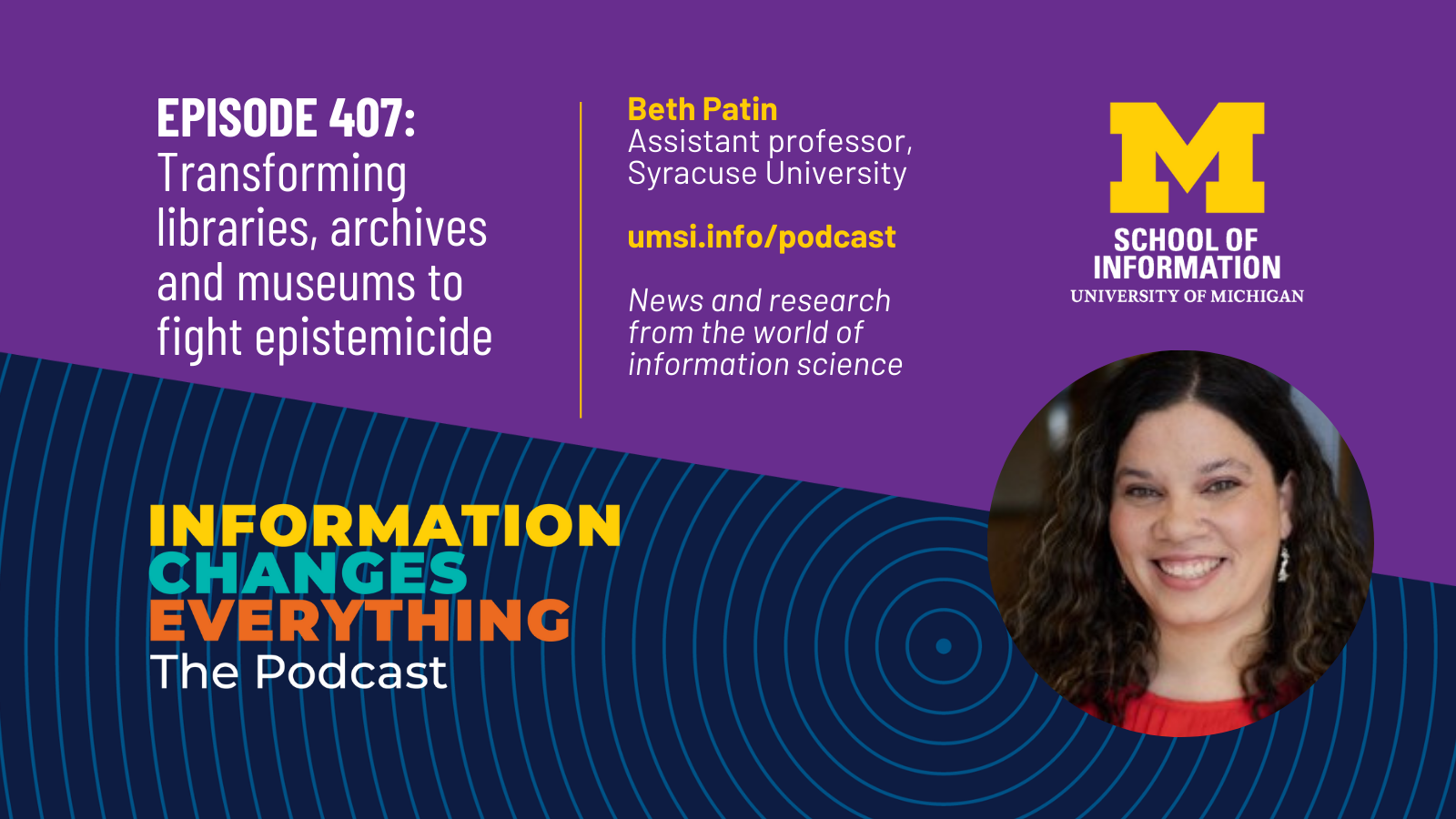
407: Transforming libraries, archives, and museums to fight epistemicide with Beth Patin
Listen to UMSI on:
Information Changes Everything
News and research from the world of information science
Presented by the University of Michigan School of Information (UMSI)
Episode
407
Released
July 2, 2024
Recorded
2024
Guests
Beth Patin, assistant professor, Syracuse University School of Information Studies
Summary
In this episode of “Information Changes Everything,” Beth Patin, an assistant professor at Syracuse University’s School of Information Studies, looks into the transformative potential of libraries, archives and museums in combating epistemicide. Through compelling case studies and historical analysis, Patin discusses the profound impact of epistemicide on individuals, communities and societies, and emphasizes the urgent need for action.
Resources and links mentioned
- Full video of Beth Patin’s talk on YouTube
- Christian Sandvig earns U-M 2023 presidential award for public engagement
- Steven Ong brings data science into his everyday life with the Master of Applied Data Science program
- The 7 best URL shorteners in 2024 | Zapier
- umsi.info/events
Reach out to us at [email protected].
Timestamps
Intro (0:00)
Information news from UMSI (1:30)
Hear excerpts from Beth Patin’s 2023 talk “From Erasure to Empowerment: The Role of Information in Fighting Epistemicide” at UMSI (2:39)
Next time: Anticipating AI failures in health care with Dr. Karandeep Singh (21:06)
Outro (22:04)
Subscribe
Subscribe to “Information Changes Everything” on your favorite podcast platform for more intriguing discussions and expert insights.
About us
The “Information Changes Everything” podcast is a service of the University of Michigan School of Information, leaders and best in research and education for applied data science, information analysis, user experience, data analytics, digital curation, libraries, health informatics and the full field of information science. Visit us at si.umich.edu.
Questions or comments
If you have questions, comments, or topics you'd like us to cover, please reach out to us at [email protected].
Beth Patin (00:00):
We need to be working towards addressing oppression at the institutional and societal levels. And if we are not doing that, we are spinning around in diversity 101 and that's keeping us from actually making progress.
Kate Atkins, host (00:18):
That was Beth Patin, an assistant professor within the Syracuse University School of Information Studies during a 2024 talk at UMSI. And this is information changes everything where we put the spotlight on news and research from the world of information science. You're going to hear from experts, students, researchers, and other people making a real difference. As always, we're presented by the University of Michigan School of Information UMSI for short. Learn more about us at si.umich.edu. I'm your host, Kate Atkins. Today we'll hear more from Beth Patin during her 2024 UMSI data archives and Information in Society seminar. The talk highlights the transformative potential of libraries, archives, and museums in fighting against epistemicide. Epistemicide is the killing, silencing, annihilation or devaluing of a knowledge system. Through case studies and historical inquiry, she'll highlight the consequences of epistemicide for individuals, communities, and societies. And we'll explain why we need to take action. Before we jump in
(01:31):
a few other people and projects that you should know about UMSI. Professor Christian Sandvig was honored with the 2023 Presidential award for public engagement for his significant contributions in arts leadership and computer algorithm auditing. Next, inspired by his experience taking UMSI Python courses during the COVID-19 lockdown, Steven Ong decided to enroll in our master of applied data science program. This program equipped him with valuable skills that he applied in his role as an investment director and in personal projects like developing predictive models for tennis strategies. Finally, people looking for a user-friendly alternative to those cumbersome strings of gibberish in many URLs will appreciate Zapier's list of the best URL shorteners of 2024. The list was mentioned in the UMSI newsletter which features tiny delicious news tidbits like this. For more on all of these stories, check out si.umich.edu or click the link in our show notes now back to Beth Patin.
Beth Patin (02:41):
So the outline for my talk today is that, first I want to tell you a little story about my family, and the story doesn't start with me. It really starts with my grandfather. He knew that he wanted to be a doctor, a medical doctor from a really young age, and he had a lot of hustle. He wanted to get a chemistry set and his parents were like, no, we can't do that. But they gave him a plot of land and that little kid grew vegetables and then rode his bike to the farmer's market and sold vegetables and fruit so that he could buy his first chemistry set, right? But in Alabama in the 1940s, he couldn't go into our public library. And that really bothered him. And he talks about this in his biography. If I wanted a particular book, I borrowed it or hoped some friend or relative had it or something similar.
(03:27):
And sometimes we'd even pick books out of the trash. This library business really bothered me as I had a thirst for knowledge. My family paid taxes and still I couldn't use the library. And we often think about libraries and information as being really democratizing, but for whom is a question that we should constantly be asking ourselves. But he did go on to be a doctor. In the state of Alabama there was no place for a Black man to get a medical degree in 1940s. So we had to go to Tennessee. He went to Tennessee, he went to do his residency up in Chicago where he met a beautiful nurse and wooed her and wanted to talk her into moving back to Alabama. And she really didn't want to. She said, we can go to the movie theaters, we can go to restaurants. Our kids could go to school.
(04:15):
Why would we go back to Alabama where everything is segregated? And he said, if we don't do this, who will? So when he got back to Alabama, he opened his medical practice and his friend John Cashin opened a dental practice and together they decided to form this organization called the Community Service Committee. This committee was organized around desegregating Huntsville. They wanted to work towards equal rights for everyone in the community. So they started doing things like poster walks. They would go to movie theater lines where people weren't allowed to go to movie theaters and they'd buy tickets, they'd turn them down, they'd get back at the end of the line, and they'd do that all day long so the movie couldn't sell tickets. And that worked for a while. But the newspapers, the media wouldn't pick it up. They didn't care enough about these stories.
(05:08):
So the community service committee came up with an idea, Hey, what if we get a fancy lady arrested? What if we get a prominent woman in society arrested? And so in April of 1962, my grandmother, along with Mrs. Joan Cashin, Martha Adams, went to Walgreens, ordered a cheeseburger and got arrested and they sentenced her to jail. And at that time, she was six months pregnant. Well, this did make national news. This story traveled really far and not just in the Black newspapers. It was in all of the newspapers. And there was kind of a general concern about pregnant women not getting to eat when they were hungry. That was a thing that many people could understand. After this point they went to protest at the stock exchange. Shortly after that restaurants in Alabama were integrated, and my grandparents were the first Black people in Alabama to integrate restaurants.
(06:02):
But again, attention kind of wavered. And so my grandfather had this idea, what if we bring in this dynamic speaker? I saw this young guy talk in Florida, and he was pretty radical and pretty cool. What if we bring him to Alabama to energize the people? And so they invited Martin Luther King to come and speak in 1962. And Dr. King said, we have to integrate the schools. All of the things that you are doing are great, but if we don't start with the youngest kids and work on their knowledge development, then it's going to be too late for the adults. So in 1963, my family sued the Board of Education in Huntsville, Alabama, and we knew that this was going to be an easy lawsuit to win. Brown versus Board had happened almost a decade before. So the legal precedence was there when they tried to go register for school the first Tuesday after Labor Day, which was traditionally when school started, Governor George Wallace sent state troopers to keep my dad from registering for school.
(07:04):
There's a lot of misnarratives about this day. Lots of people will say it was not violent. The clan was threatening them, the police are there. After that day, my grandfather had to send a telegram because that was still a thing. I took my son to Fifth Avenue. Sergeant of the Highway Patrol met me and said, school is closed on Governor Wallace's orders. You can't go in. And I didn't see anyone else enter. And of course, the federal government got involved contrary to Governor Wallace's wishes on September 9th, 1963, President Kennedy sent down Secret Service to help keep these children safe. My dad was the first Black man in Alabama to desegregate schools. And so at this moment, on September 3rd, 1963, education in the state of Alabama changed forever. I think it's important to note that our family continues to file this lawsuit. The state of Alabama until September of this year, September of this year, had not met the federal requirements of the lawsuit.
(08:13):
It took them 60 years to meet the policy guidelines. We finally dropped the lawsuit on the 60th anniversary. It's important for us to think about these stories historically, but also the state of Alabama says, the kids should know our history. They should know these things. But when we look at the Alabama archives and the Department of History, and if you search my dad's name, there's one entry, and it's from photographs from the 1974 Institute of the NAACP Legal Defense Fund in New York City. So it's celebrating 20 years of Brown versus the Board of Education. So how does this happen? How does it happen that a state archive, who knows that this type of history is important for our students to learn, has no materials? Well, in 2020, the Department of Archives in history came out and said, we have intentionally collected the history of Confederate and white Alabama, while also intentionally deciding to not collect Black history.
(09:16):
They have not been willing to put in the financial resources to preserve these materials. And in fact, I have reached out to them for three years about taking my family's materials, zero interest. How does this lead to the oppression of knowledge? There has been lots of tidbits as I've talked of things that were unjust that my family had to go through to get education. So I want to start us off with some questions. As we think about knowledge oppression. As information professionals, academics, how do we support people's capacity to know? Our jobs are to support people's ability to know and understand the things that we're talking about, right? We want to think about how do we help y'all grow as knowers? But I also want to encourage us to think about how do we harm people's capacity to know? When do our behaviors keep someone from participating?
(10:07):
When do our words invalidate someone's experience and make them feel like they can't say something? All of those are part of this knowledge ecosystem. And then a little deeper, who do we support and who do we harm? This isn't like we help all these people, but some of these people we are thinking about helping constantly. Some of them we are not. So this concept of epistemicide comes from de Sousa Santos’ work. And so we define epistemicide as the silencing, devaluing, killing, or annihilation of a knowledge system. This is the way we destroy other ways of knowing. We can think about the knowledge that was lost in the transatlantic slave trade when we took Africans, enslaved them, and we removed their language, their religion, their names, and asked them to rebuild themselves. We can think about women that were persecuted and killed in Massachusetts for women ways of knowing where they were named and called witches and burned at the stake.
(11:10):
We can look to the harm that was done in Indigenous boarding schools when the specific federal mandate was to kill the Indian and save the man. Think about what that means. It means to remove all of their cultural knowledge and leave them as an assimilated U.S. or Canadian citizen. So I don't think it has to happen, epistemicide doesn't have to happen in these huge, large, destructive ways. We can all experience epistemic injustices along the way. And I think epistemicide really reflects the structured and systematic oppression of knowing. And it can happen with all these small slights. So Miranda Fricker tells us that an epistemic injustice is the wrong done to someone specifically in their capacity as a knower. And she gives us a couple of terms, which I will talk about each of these, testimonial and hermeneutical, and we've come up with some more.
(12:10):
I do not think this is it, but we've shared participatory, curricular and commemorative. So first, Fricker tells us that testimonial injustice is when a prejudice causes a hearer to give a deflated level of credibility to a speaker's word. So I like to use sender and receiver because it's less ableist, but these are Fricker’s terms. The example she gives us is Tom Robinson in To Kill a Mockingbird. She says, Tom was honest, his testimony was truthful, but because the jury was prejudiced they could not believe his testimony. But this happens all the time. You've ever been in a meeting where you didn't have enough power for your voice to be heard or for your suggestions to be taken seriously. Hermeneutical injustice is a gap in a collective interpretive resource creating a barrier for someone who is trying to make sense of their own social experiences. And I think Fricker has this right. But I think this is limited because I think this also comes up when we don't have enough understanding to help us make sense of someone else's experience. So if I've never experienced racism, I don't believe it exists. If I haven't had to think about oppression, I don't have the tools or the language to talk about intersectionality or oppression or those experiences, and that becomes somebody else's job.
(13:41):
Participatory injustice is the exclusion of one's own participation in their own epistemological development. And this can be something like my grandfather who could not go into the library, also couldn't get into medical school. But it's also things like keeping people out of the loop. So once he became a medical doctor, they wouldn't let him go to the medical conferences, and then they started to let him go, but he had to sit in the kitchen. Then they started to let him go, but he had to sit behind a curtain. The way you could participate was really different. And so yes, those things are terrible, but also if we're keeping secrets, that can also be this participatory thing. If there is a hostile environment amongst students, we can see these kinds of injustices happening. Like if all of a sudden it doesn't feel safe for you to participate in class, that this is happening.
(14:35):
So then curricular injustice. This happens when physical resources are not available to support the epistemic growth or are used to suppress and eliminate the creation of rival knowledges. Carter G. Woodson told us a hundred years ago that we were educating everybody about the Negro. He says, from the teaching of science, the Negro was likewise eliminated. The beginnings of science in various parts of the Orient were mentioned. But Africans' early advancements in this field were omitted. Students were not told that the ancient Africans of the interior knew sufficient science to concoct poisons for arrowheads, to mix durable colors for paintings, to extract metals from nature and to refine them for the development in the industrial arts. He says, we often only talk about Black communities in relationship to the experience of slavery, and therefore we continue to perpetuate this myth that they are just slaves and only slaves.
(15:37):
And that has not just done damage to Black people in their own epistemological developments, but how the rest of the world perceives them as well. We can also look at the kinds of books that are getting banned. I don't think that we should be naive about whose books and whose communities are being banned in the United States. Characters that are of different races or queer are making up a high percentage of what is getting banned, but including books that are talking about race and identity. So not even having characters of color is enough to get your book banned. And so then the last injustice I want to talk to y'all about before I get into some of the solutions is commemorative. Commemorative injustice encompasses our participation and acts of commemoration and the way we interact with tangible and intangible cultural heritage. We might think about not returning documents that belong to the National Archives when we were supposed to give them back already.
(16:35):
We can think about that example I gave you from the Alabama Department of History where we see those archival silences where they have decided to not commemorate or memorialize the integration of schools. Often when I go into archives, even if these materials have been kept about the Black community, they have not been described, prioritized, digitized, and made available for the collection, willing to do that work. But a lot of folks aren't harmful, and it's harmful in a lot of ways. So Fricker tells us about the primary harm and the secondary harm, but the harm is way worse than that. There's a third level harm that she doesn't get into. So when I started at Syracuse, somebody important told me to, and I quote, keep my work out of the diversity ghetto, unquote. I was hurt, still angry, right? Still hurt because it's not the kind of thing that can happen once.
(17:33):
And you get over, well, y'all might be better people than me, but I'm petty. It still makes me mad. So that hurt was caused then, but it's repetitive, right? But not only was I harmed, now all of a sudden I don't feel safe speaking up about issues of diversity, equity, justice in my faculty meetings. So now, not only am I harmed, but my whole community is harmed because I'm not going to participate the same way. So now you all have lost the ability to learn from me because I am not an equal participant. But what happens if we've done that in the past and we've kept scholars from coming into our institutions because their work was a little bit different than ours, or we didn't understand its value, and now we've collectively lost out on an opportunity to learn from them for forever. If we don't go back and collect those stories, they're going to be gone.
(18:30):
There's going to be nothing that we can do to fix that once the time has passed. And I really think about that as a ripple effect. It's important for us to understand that the violence of erasing knowing afflicted upon one generation is going to impact the next. So as librarians, as academics, as scholars, we like to think we know. And so we select readings that we like and we pick the curriculums that we like. And so who's getting — we are doing this from a good place, but we can still do this harm even when we're meaning to do our best. And that can be really hard to point at these things, and it can also make people really defensive when you start to point these things out. And that's what I hope some of this epistemicide work does, is give us some language to talk about some of these experiences that we've had.
(19:22):
So how do we move towards justice? So I think it's important that we're critical about our norms, cataloging, design, reference, all of the stuff that we do so that we can be cognizant about if those things are destroying ways of knowing. I think one of the things that we often see is that for most organizations, we are only willing to work on these first two layers of oppression. We go to bias training and we should. We should think about our own unconscious bias. But that's not going to make everybody paid equitably. It's just not. We need to be working towards addressing oppression at the institutional and societal levels. And if we are not doing that, we are spinning around in diversity 101, and that's keeping us from actually making progress. And we'll do that because that’ll kind of keep folks off our back institutionally. If we throw a little Juneteenth at you, nobody's going to be mad about racism. So my push for y'all is to move from being mitigative to just responding when things happen, to work towards being transformative, acknowledging that inequity is predictable, persistent and unacceptable. Having a vision and a plan. As librarians, you should not be waiting for somebody to come in and challenge books. We know that it's happening. We should have a plan. As institutions, as teachers, as professors, we know that things are unequitable. What is your plan?
Kate Atkins, host (20:56):
You can watch the full talk by clicking the link in our show notes. To learn more about upcoming events like this, visit us at umsi.info/events and tune in next time to hear from Karandeep Singh's talk during UMSI’s 2023 Data Science and computational social Science seminar series. Karandeep Singh is an associate professor at UMSI and Michigan Medical School and the Associate Chief Medical Information Officer for Artificial Intelligence at Michigan Medicine.
Karandeep Singh (21:29):
And so one place we've been active is just making sure when there are opportunities for public comment that we actually put together public comments. And so we had one that was co-signed by 60 folks across the world who are kind of experts in AI and health, who really just advocate for, please just tell us the basic ingredients of the model. Let's start there. There's all kinds of fancy discussions you can get into around like Shapley Values or weird interpretability techniques for models. But the first thing is we can't debate the recipes if we don't know what the ingredients to the recipes are. So let's make the ingredients public knowledge
Kate Atkins, host (22:03):
That's in our next episode. Before we go, did you know that UMSI has an exciting curriculum for augmented reality and UX applications in the automotive industry? We're helping to create the next generation of leaders for the industry synonymous with Michigan. Head to our show notes to find out more about our auto UX offerings. The University of Michigan School of Information creates and shares knowledge so that people like you will use information with technology to build a better world. Don't forget to subscribe to Information Changes Everything on your favorite podcast platform. And if you've got questions, comments, or episode ideas, send us an email at [email protected]. From all of us at the University of Michigan School of Information, thanks for listening.